
Co-
authoring black identity in South Africa
For centuries, the authors behind mainstream narratives on black identity have not been black themselves. In an attempt to rectify this, black people have ventured to claim the stories around their own identity. This venture entails grappling with the reality of blackness and embracing the complexity of it all.
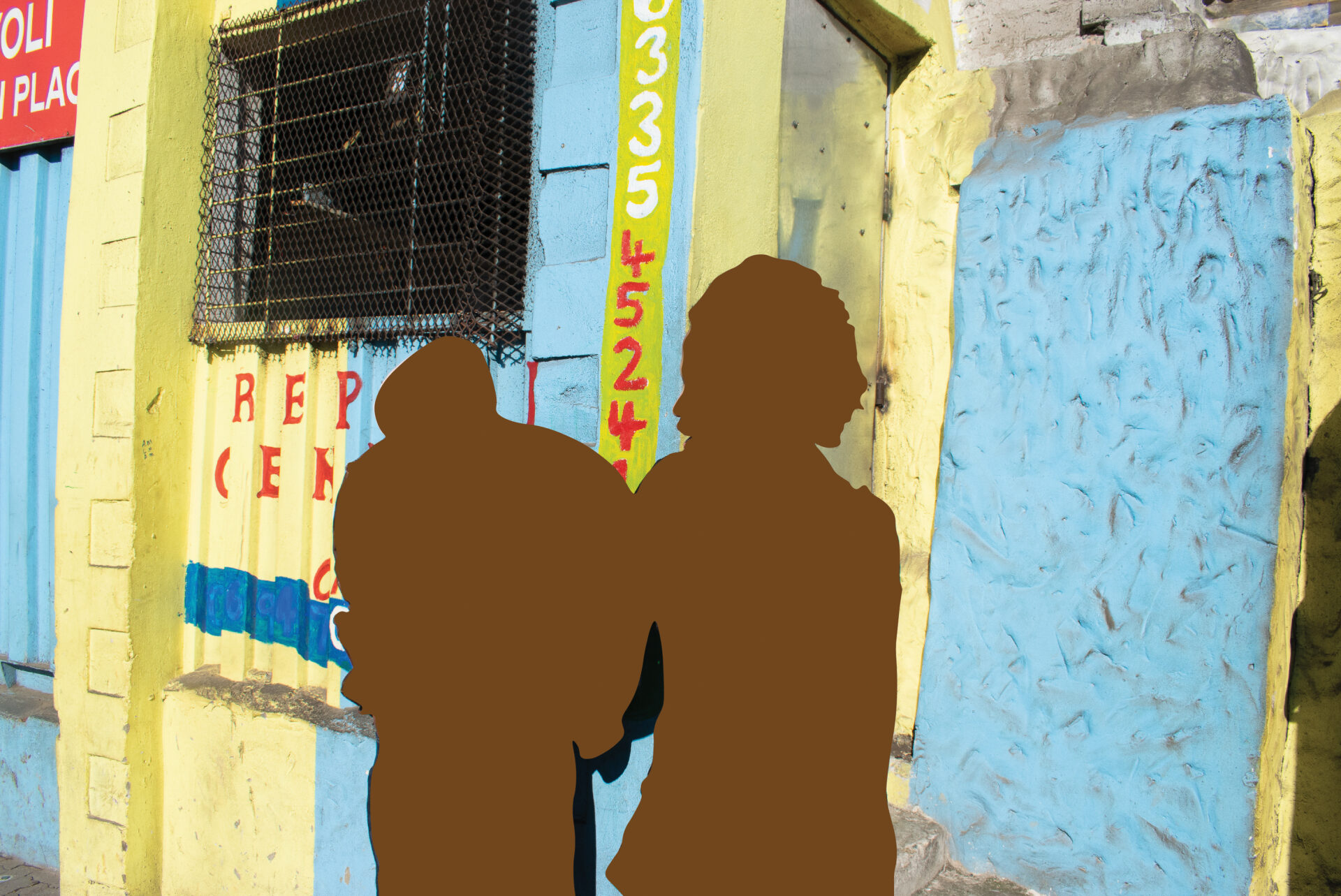
A young man navigating the central district of Cape Town is exemplary of the black people who hope for a better future in South Africa.
Bave Booi, a creative and content creator based in Cape Town, actively contributes to rewriting the narratives surrounding people from townships.
Booi says he achieves this by producing content that promotes the subcultures of Kwaito and Pantsula which emerged from townships.
“How I dress [is representative] of how I grew up,” he says. “Growing up and understanding […] what [my elders] were representing, it’s a thing [to be] proud of.”
His creative work, which can be seen on Instagram and TikTok, is a reclamation of the conditions that resulted from spatial planning pre-dating democracy in 1994, he says.
“We were put ekasi [in townships],” he says. “We didn’t decide to be there.”
According to Craig Schwabe’s research from 2024, nearly half of South Africa’s urban population resides in townships.
Today, townships are ridden with high rates of unemployment, poverty and limited access to good education and quality health care, writes Schwabe.
Booi chooses to claim the subcultures that stemmed from the conditions of townships. “We are just taking [those subcultures] and representing it and saying: ‘We are proud of this’,” he says.
“My [personal] brand is against all odds,” says Ngwanako_kasii, founder and creative director of BA.GGAGE, a handmade lifestyle bag brand. Her preferred name, Ngwanako_kasii means ‘child from the township’.
Graphic: Buhle Bam
Her mission is to represent those who have come from a township, stating her belief that this is a testament to not being able to change where you came from and to therefore embrace it.
“It doesn’t matter where you come from […], you need to work hard,” she says.
Booi and Ngwanako_kasii believe in the power that black culture and fashion have to inspire change.
“You kind of get a message, you know, as a black child, that you have to hustle,” says Booi.
Hereby, the music Booi shares on his platforms and the clothes he wears in his content, are not only related to aesthetics but seek to inspire his black audience, he says.
‘Better blacks’
Thandile Ngxikwe, who grew up in Delft, Cape Town, says that she was not confronted by the realities of her black identity until she had to attend a school outside of her township.
“Education, inherently, […] was not built in black townships […] to the highest standard as elsewhere,” says Dr Mosa Phadi, a sociology and social anthropology lecturer at Stellenbosch University (SU).
Phadi corroborates a trend of parents and caretakers sending their children to schools outside of rural and township environments for better education.
In her younger years, Ngxikwe was enrolled at a predominantly Muslim and coloured school. It was there where she noticed the tendency of individuals to identify as coloured as a claim to have a greater proximity to whiteness, she says.
Similarly, she reflects on how her attending a predominantly coloured school also placed her in proximity to whiteness in the eyes of her community members, thereby classifying her as a “better black”, she says.
“I think when my blackness became challenged was when the influence of my schooling started to become more and more apparent,” says Ngxikwe.
There was a point in young Ngxikwe’s life, she says, where she would try to assimilate to colouredness by changing the appearance of her hair and choosing to befriend coloured kids over the other black kids who attended the same primary school.
“Those are real traumas that came with just being around coloured people and always feeling like being black is not enough,” she says.
The complexities of Ngxikwe’s identities became very prominent to her in university but that was the beginning of her embracing it, she says.
In the university space, she says, there were times where she was considered “a hood rat” – a term often derogatively used to refer to someone from a township.
For Ngxikwe, who is currently a business consulting intern, it was not a matter of identifying as a “hood rat” or a “better black”. She says that she held both identities with pride by embracing a more fluid black identity.
Re-occupation and re-education
Meanwhile, an established black academic reached a point of reckoning in his life.
He reached a point where he had to decide whether he would be part of the tiresome exercise of racial transformation or continue on the path of enjoying the fruit of transformation in other spaces.
“I came back when it finally clicked what I can do,” says professor Kopano Ratele, a professor in the department of psychology at SU as of 2021, following a brief break from teaching.
The main motivator behind his break from teaching was the lack of opportunities to explore topics of interest such as race, in a way that he thought was necessary in South Africa, he says.
According to Ratele, he was involved in activism challenging the publication of racist academic work that undermined the intellectual capabilities of coloured women.
After this, Ratele says he felt called to address certain issues at SU following numerous job offers he had received from tertiary institutions stemming from his political activism.
Today, Ratele believes that he impacts two specific groups of students who attend the university, as intended in 2021.
“I wanted to come here for the black students because I realised that if they’re in a minority [on campus] in their country, they might feel that they are visitors,” he says.
Graphic: Buhle Bam
He believes that his presence offers black students the support that they might require in a majority white learning environment.
Ratele says that he advocates for the humanisation of black students by debunking the prevailing myths around blackness. He says that he debunks the myths that inform misguided white students’ understanding of black people. Some of these myths pertain to the perceived inferiority of black people.
“I [wanted] to teach white students to see how they are reproducing the system just by being here. [It is] something that’s not always their fault,” says Ratele.
Hereby, Ratele slotted himself into the collective project of education around the complexities of black identity and decoloniality.
According to Ngxikwe, fundamentally, decoloniality exposes colonial lies.
“Colonialism lied,” she says. “They institutionalised the lies.”
The truth is more dynamic and has more depth, says Ratele.
“Blackness is everything. Blackness is big and small. [It] is violent, is caring, is all that humans do in the world,” says Ratele.
Black is politics, politics is black
Phadi makes the case for a complexity of black identity that leans towards the political.
“[Steve] Biko talks about black as an orientation,” says Phadi. “It’s a sense of being in the world as a political orientation. It’s an ideological orientation.”
Blackness in South Africa has particularly been tuned into politics as a means of reclamation and upward mobility, she says. Over and above the economic aspirations tied to it, it has become a political orientation due to centuries of oppression, she says.
According to Phadi, the pursuit of freedom from these circumstances has led to the deeper fragmentation of black identity.
The ideological divisions amongst the majority of black South Africans is a by-product of the long struggle of black liberation, she says.
Graphic: Buhle Bam
“[The black population is] influenced by many things because they [want to] find their freedom,” Phadi says. “Some of them become liberal, aligned [and], assimilated to the cultural whites. Some of them become conservative. Some of them become radical.”
These ideological breakdowns boil down to the simple desire for self-determination in the epoch South Africa finds herself in, says Phadi.
This summarises the political orientation of black South Africans, 31 years after “[the amalgamation of] the apartheid regime state and [the] new state”, according to Phadi.
Black women and intersectionality
Gender is the main lens through which Ayanda Nyoka, business owner of Zombini Solutions and an independent social impact programme consultant, makes sense of her identity.
“At [a] point in my early 20s, for me, […] race was a strong kind of primary identity,” says Nyoka.
The transition of becoming aware of the specific plight of black women in South Africa was only a recent process for herself, says Nyoka.
“[The process is] the integration of becoming aware of particular struggles and challenges that I face because of my gender and coming more fully into my womanhood,” she says.
Over and above that, Nyoka says that she aims to live more presently as a mother in 2025.
“Over the years, you know, you start to kind of think about […] the pain that […] hasn’t been worked through, right?” she says. “So, I’ve become quite protective of my own child […] I actually don’t want him to just take on these narratives.”
Nyoka says she aims to change the narrative surrounding black identity through the lessons she teaches her son.
“I’ve been doing this now for […] the last three years, to pause and to say, ‘Listen, when this person said this, actually, you know, this is not how it is’,” she says.
Under the parental guidance of Nyoka, another black boy gets to develop a renewed sense of identity. On this path, his identity will be stripped of the lies and empowered by the promise of a brighter future.