Stellenbosch volunteers are stepping up to feed, clothe and provide shelter for the unhoused and vulnerable. However, with limited resources, questions remain about whether charity alone can address the town’s growing homelessness crisis.
Uendjizuvira Kandanga
By noon, the queue outside the Stellenbosch Town Hall stretches around the block. Inside, volunteers bustle between tables stacked with blankets, toiletries and hot meals.
What seems to be an ordinary clothing drive is something more: A pop-up “store” where unhoused and vulnerable people can choose what they need and, in doing so, reclaim a sense of dignity that they are often denied, according to a social media post by Serve Stellenbosch.
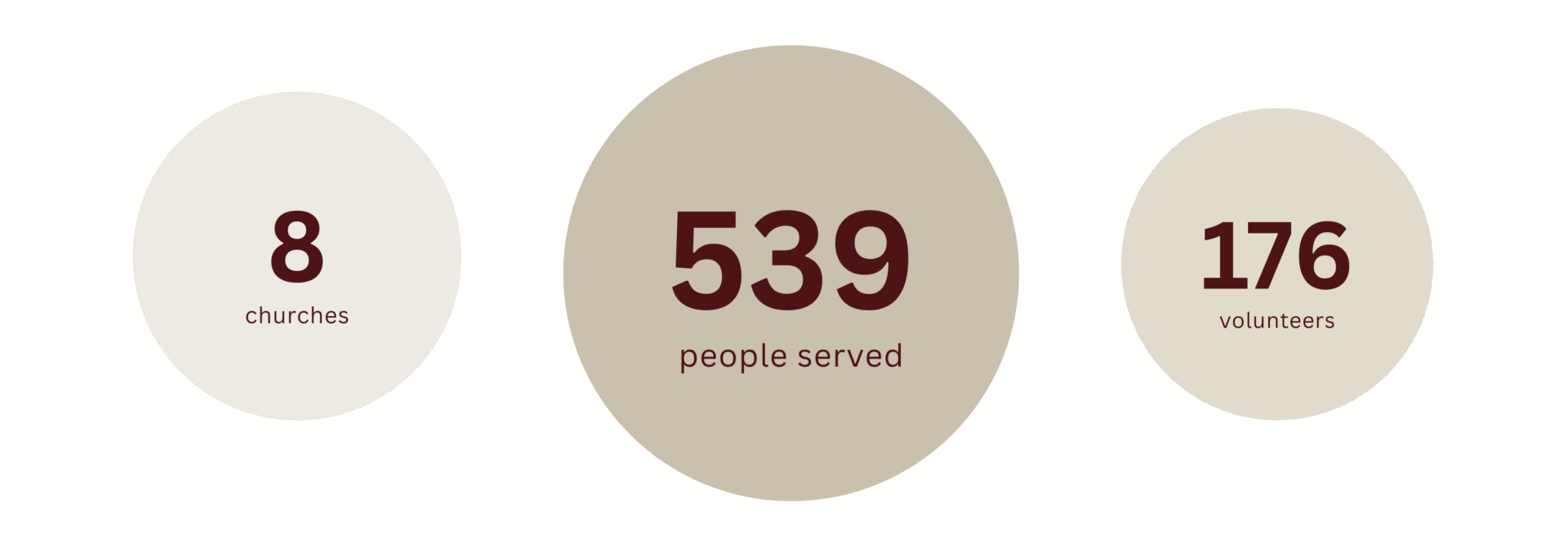
In a single day, Serve Stellenbosch, a Christian ministry that provides support to the greater Stellenbosch community, served 539 people – a reminder of both the scale of the need and the power of collective action.
The pop-up “store”, better known as the annual Street Store Winter Readiness Outreach, is a collaborative effort between Stellenbosch Municipality and Serve Stellenbosch.
This is according to Stuart Grobbelaar, communications manager for Stellenbosch Municipality.
This is one of many initiatives that sees a need and intercedes to bring about change for individuals in need.
INFOGRAPHIC: Uendjizuvira Kandanga
Houselessness varies across provinces due to migration, economic activity and unique social issues. The Western Cape, for example, experiences significant high costs of housing and a high prevalence of substance abuse, according to Statistics South Africa’s (StatsSA) 2022 census report.
The number of persons classified as “homeless” in South Africa increased substantially from 13 135 in 1996 to 55 719 in 2022, according to a report published by StatsSA in 2025.
According to the report, the leading causes of houselessness are unemployment, divorce, arguments with family, domestic violence and neglect, with 44% of the population being made up of persons aged 15-24.
“Stellenbosch is our space and we should take responsibility for that.”
Homelessness is not homogeneous
“Think about how many people are vulnerable to homelessness or just in vulnerable positions,” says Merin Jacob, the chairperson of Stellenbosch Homelessness Forum (SHF).
“We think homelessness is kind of homogeneous, that there’s one group of people and they all share the same characteristics. But that’s definitely not the case.”
Those rendered houseless often feel invisible, and are treated as if they do not belong in Stellenbosch, says Jacob.
The SHF’s key objective is to shift the public’s perceptions of the unhoused in Stellenbosch, says Jacob.
The perception should move from it being something to be solved by someone else to rather being viewed as a challenge that requires the collaborative effort of the whole of society, she says.
In an attempt to create lasting change, they connect houseless and vulnerable people to the Stellenbosch Night Shelter, where they can have a place to eat, shower and sleep, as well as receive identification documents, according to Jacob.
People think that the government should provide a solution, Jacob adds. However, the government itself may lack the resources needed in order to address these issues, she says.
“And so, instead of waiting on the sidelines, it’s really important that we get involved because it’s our space,” she says. “Stellenbosch is our space and we should take responsibility for that.”
“We think homelessness is kind of homogeneous, that there’s one group of people and they all share the same characteristics. But that’s definitely not the case.”
Support despite circumstances
Many people facing homelessness are hard-working individuals who have fallen on hard times, says Simbirisiyo Mushanewana, the founder of a soup kitchen named Donations on Wheels.
Mushanewana, who is now a third-year theology student at Stellenbosch University (SU), says he experienced homelessness three separate times in his life, with the most recent being in 2019.
According to Mushanewana, unhoused people want to leave their circumstances, but struggle to, and others do not have identification documents, making it difficult to find work.
Some work in gardens, he says. Others wake up at 4:00 to collect scrap from bins.
“I have seen some of the homeless joining construction through markets on street corners,” he says.
Only the Stellenbosch Night Shelter has an explicit mandate to serve those who are houseless, says Grobbelaar.
According to the shelter’s website, they provide for 30 men and 12 women.
A coupon a day
Stellenbosch University (SU) is also involved in helping the houseless and vulnerable communities, in partnership with the local municipality.
This is according to Michelle Pietersen, manager of engaged citizenship at SU’s centre for the advancement of social impact and transformation.
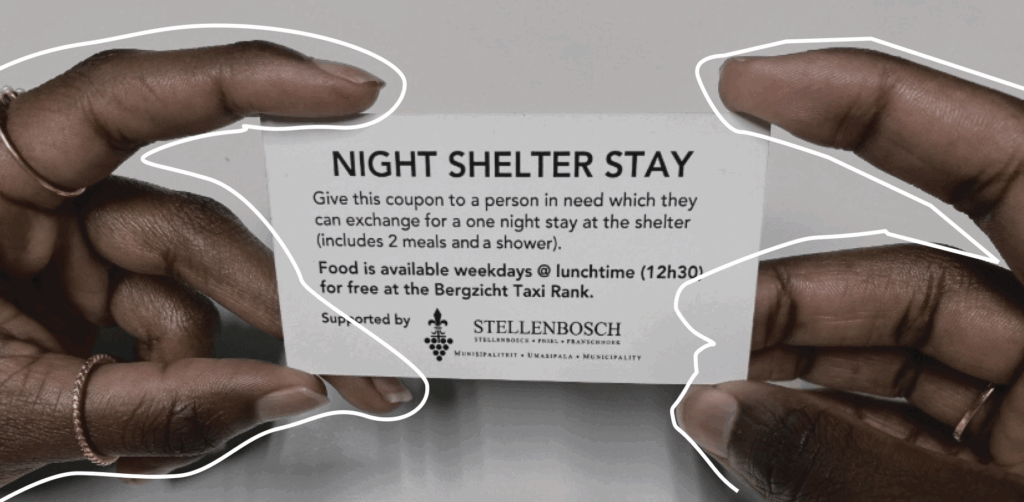
SU has established a program that allows students to purchase a coupon from the Stellenbosch Night Shelter, Pietersen says. Rather than giving money to a houseless person, individuals give them a coupon, which provides access to a shelter, food, a blanket and a place to sleep.
“That is also an important point to understand. People think, ‘I must give people money, and that’s going to make the problem go away’. We’re actually creating more problems because you don’t know where that money is going to end up,” says Pietersen.
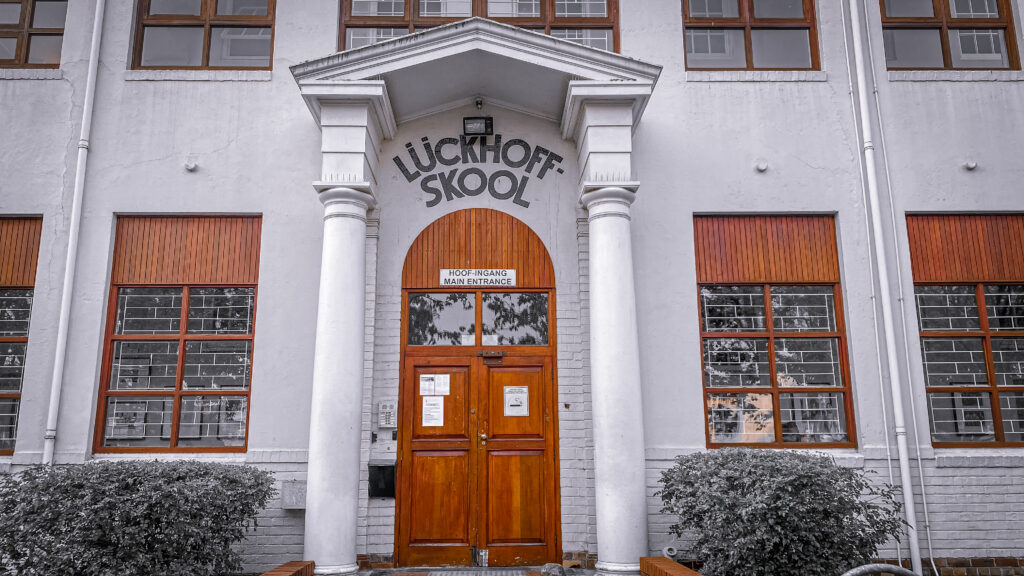
Stellenbosch University’s centre for the advancement of social impact and transformation is located in the Old Lückhoff-Skool building. PHOTO: Uendjizuvira Kandanga
Help in reach
Evictions are one of the chief contributing factors to houselessness; Stellenbosch does not have emergency accommodation in the case of an eviction.
This is according to Nikita Stander, the deputy head and senior attorney at the SU Law Clinic.
“We try to stop evictions by telling the court that if these people are evicted, they will be left homeless,” Stander says.
“Unfortunately, eviction orders are still granted, even though the municipality says in their reports that they can’t assist with housing.”
Evictions occur due to plenty of reasons, such as employment contracts ending, as is the case for many farm workers, which then results in their housing also coming to an end, says Stander.
“A lot of those matters are family-related, so, [for example], the brother applies for eviction of the sister [if] the brother inherited the house,” she says.
As a free legal service provider, she says they assess all clients by following a means test – which evaluates whether the applicant’s income falls below a specific threshold – and whether their individual situation is applicable within the context of the Extension of Security of Tenure Act 62 of 1997, which protects people living and/or working on rural or agricultural land owned by someone else.
“We try to stop evictions by telling the court that if these people are evicted, they will be left homeless.”
Meanwhile, Mondays to Fridays, another organisation works to provide daily meals at the Bergzicht Taxi Rank on the corner of Bird Street and Merriman Avenue, says Liesel Koen, project manager of Stellenbosch Feeding in Action (SFA).
SFA is a longstanding local feeding scheme operating from Kayamandi, Stellenbosch, which focuses on providing balanced meals to people in need, according to Koen.
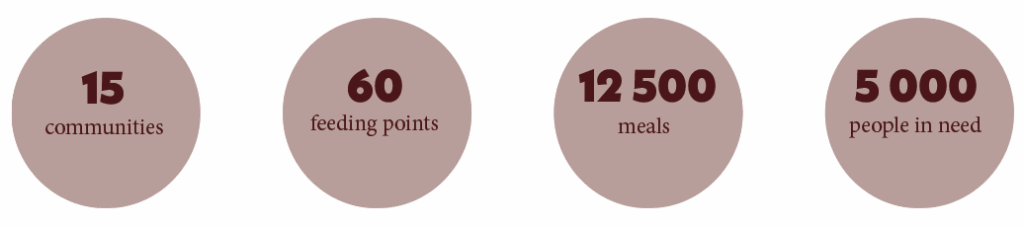
The organisation has 60 feeding points across 15 communities and its vision is to feed people in “a humane way” to improve their quality of life, Koen says.
“In other words, [providing] nutritious meals to those in need is our contribution to restore dignity to our beneficiaries.”
SFA caters to over 5 000 people in need, with a focus on vulnerable children, amounting to approximately 12 500 meals per week, says Koen.
Stellenbosch Feeding in Action provides 12 500 meals per week to over 5 000 people in need. Operating from Kayamandi, this organisation has 60 feeding points across 15 communities. INFOGRAPHIC: Uendjizuvira Kandanga
Crossing traditional boundaries
There are two extremes when it comes to how students at SU generally perceive houselessness in Stellenbosch.
This is according to Abigail Larsen, a third-year BCom (International Business) student.
“On [the] one hand, there are people who are very empathetic, giving people on the street money, food and clothes, offering to pray for them and listening to their stories,” she says.
On the other hand, many individuals respond with prejudice, fear and uncertainty. This is according to Larsen, who says that such perceptions often result in ignoring, avoiding or even being rude to the houseless.
She says that many unhoused people struggle with mental health challenges or substance abuse, making their behaviour unpredictable.
Formal mental health services are delivered by the provincial department of health at Stellenbosch Hospital, says Grobbelaar.
Larsen was involved in the development of a digital platform called Thallo, which was designed to mobilise a new generation of volunteers, leaders and social entrepreneurs, she says.
The hope is that such social impact applications will mobilise the youth to take action in their own communities, she adds.
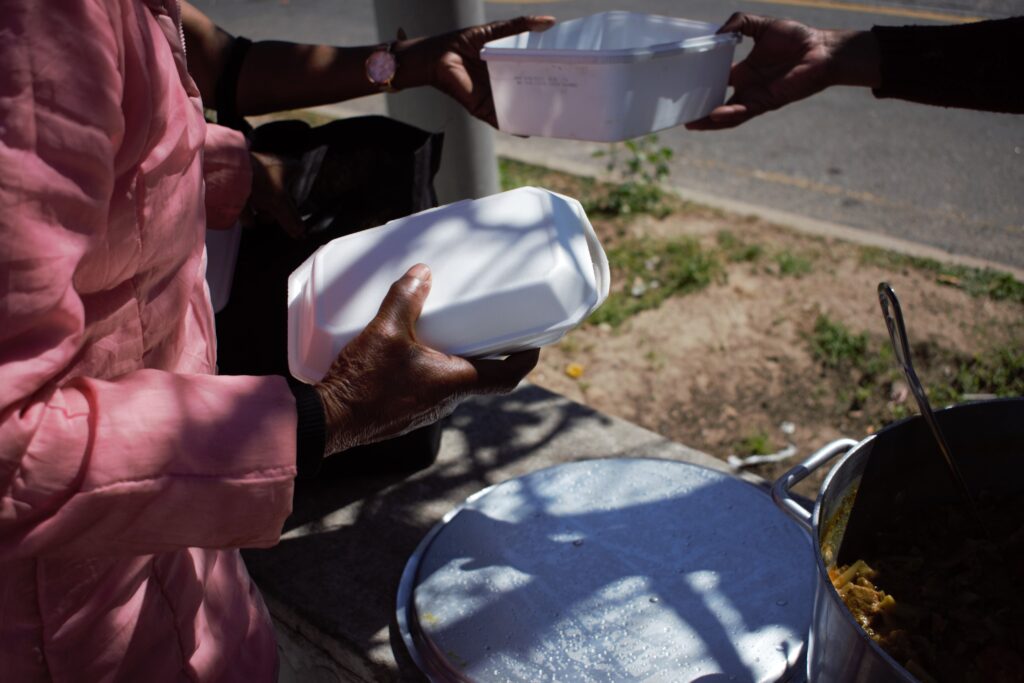
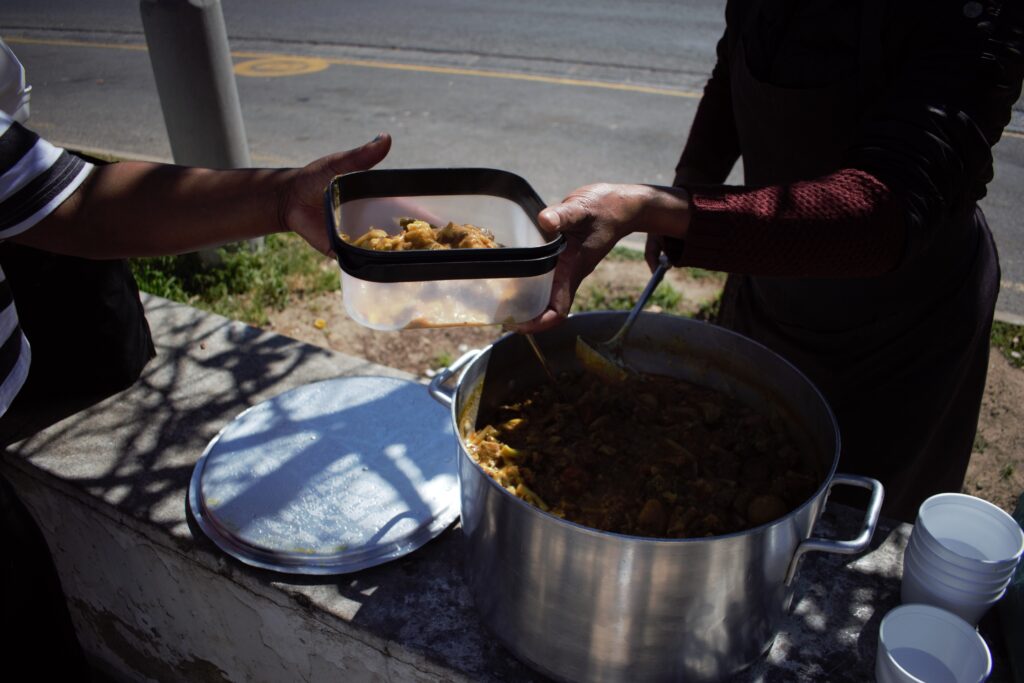
Unhoused people handing their containers over to Stellenbosch Feeding in Action to receive a meal.PHOTOS: Uendjizuvira Kandanga
‘We know how it feels’
Westiaan van der Merwe and Jolene Faro, an engaged couple, say they have submitted their resumés in search of jobs at multiple places, and Van der Merwe is in the process of obtaining his Code 14 licence in the hopes of acquiring a job as a truck driver.
“As a homeless person, you have nothing to give in return, and that’s why I’ll take my shame [and] my dignity by humiliating myself just so that we can better our circumstances,” says Van der Merwe.
They lost their retail jobs when their contracts ended and subsequently could no longer afford accommodation, he says. They have been houseless for two years and eight months now.
“As a homeless person, you have nothing to give in return, and that’s why I’ll take my shame [and] my dignity by humiliating myself just so that we can better our circumstances.”
While keeping an eye on the couple’s two children – five-year-old Luke and ten-year-old Scott – who are playing by the sidewalk, Faro says that she does not feel safe on the streets.
“We have been mugged a lot of times, and sometimes during the night you can’t sleep because law enforcement comes and chases us away,” she claims. “They don’t ask you nicely […] They kick you. ‘Come! Get up! You’re not allowed to sleep here!’”
Van der Merwe says he understands why many people avoid those who are homeless, because some may have had a bad experience with unhoused people who are “not so civilised and humble and decent like some of us”.
“We apologise for the other homeless people that are not so civilised like some of us. Because we are in that circumstance,” he says. “We know how it feels.”
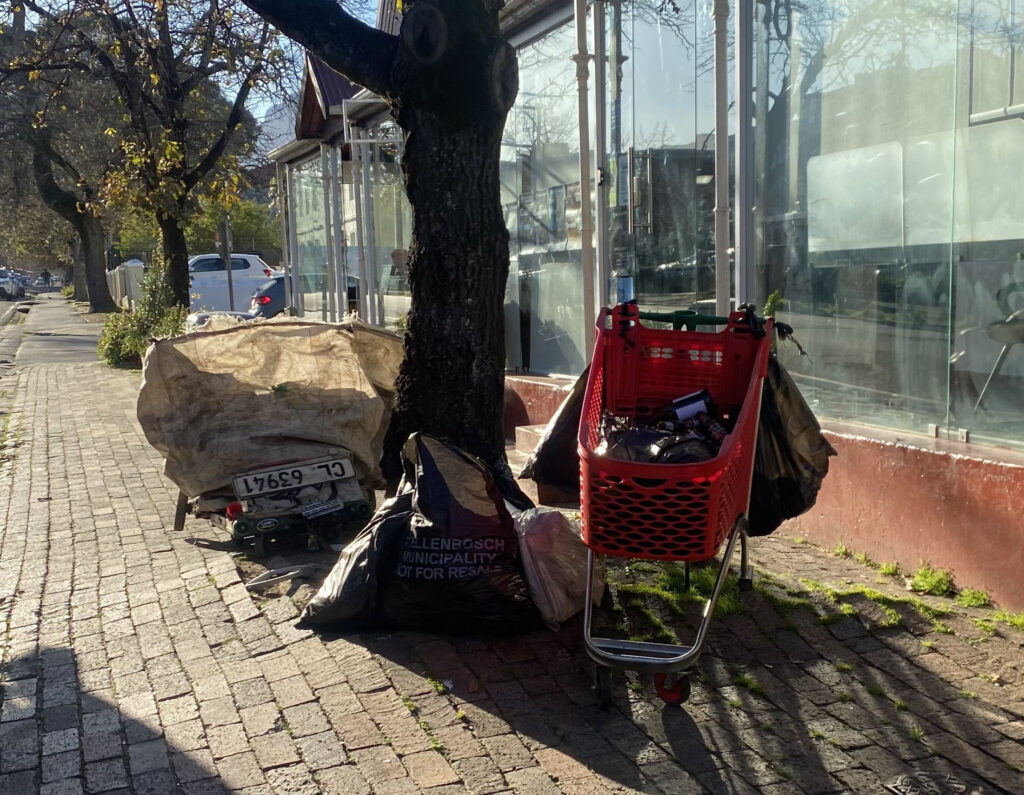
Belongings of an unhoused man parked outside CoCreate Hub on Victoria Street, Stellenbosch. PHOTO: Uendjizuvira Kandanga