
Shifting
Attention
PHOTO: Reid Donson
It’s not that people are unable to focus on things besides their cell phones. It’s that they choose not to, says professor Daniel le Roux from Stellenbosch University’s department of information science. Yet, in an age of increasing digital distraction, there are still some people who are taking active steps to refocus their attention.
It’s a crisp morning in Woodstock, Cape Town, when droves of people begin filing into an empty building. Boxes line the walls and various coffee machines stand on display throughout the space. A long line forms behind the counter, as people begin ordering coffee, while others take a seat around the room. Those who cannot find couches use the steps of a staircase, the edge of a crate shelf, or simply the floor. Within minutes, the room is filled with absolute silence.
Everyone in the room has gathered at the La Marzocco showroom at the Old Biscuit Mill for a single purpose: Reading. For one hour, people agree to sit in silence with a book of their choosing.
“People forget how much they love reading,” says Shawn Buck, who started the Cape Town chapter of the Silent Book Club in May 2024, after having visited the Atlanta chapter in the United States of America in April that year.
For Buck, the club is about fostering deliberate and intentional reading.
Robert Ketteringham, an attendee of the silent book reading session, says that the social pressure of having everyone around you reading in silence makes it easier to focus.
“If I get bored with my book, I’d be very tempted to grab my phone,” he says, regarding his experience of reading outside of these silent sessions. Here, he says, he is able to overcome that temptation.
Around 150 people gather at the La Marzocco showroom in Woodstock, Cape Town, for a silent book reading session on 3 August. PHOTOS: Reid Donson




The attention economy
“It’s actually not complicated, right? It’s a fairly simple sort of series of steps that we took to get to this point. Much of it starts with the smartphone,” says professor Daniel le Roux from the department of information science at Stellenbosch University.
“The idea that you can engage [with the online world] at any place, at any time, shifted the whole way in which we distribute attention to online media,” he says. “It means that the opportunities for cognitive engagement with online media [are] now permanent.”
Our constant access to technology has led to what is known as the attention economy, in which there is “this market of competition between online content providers and they’re using increasingly ethically grey techniques in the design of their content to try and slice off a bigger and bigger share of user attention”, he says.
There are different theories regarding how attention works. One popular theory argues that when we constantly switch our focus between different things, we are weakening our attention span, according to Le Roux.
However, he says that there is also a theory that we are actually not harming our attention span, but rather forming a habit of being distracted.
“We’re developing a habit of attentional shifting,” he says. “So, it’s not like you’re weakening the muscle, you’re just developing a pattern in which […] it becomes normal for you to shift your attention frequently across different things.”
‘To go back’
Only a few streets away from the Old Biscuit Mill, where a group of people continue to read in silence, sits a quaint second-hand bookstore. A remnant of a past world, books line the walls and overflow from tables and boxes. Chris Ormrod, who co-owns the store with his wife, Dianne, sits at a book-filled desk in one of the store’s side rooms.
Ormrod has run Paper Moon for about eight years. While primarily a second-hand bookstore, Paper Moon is also filled with antique items, fun curios and 60s music that all harken back to a time before technology.
“I think a lot of people seem to want to go back,” he says, referring to a pre-digital era.
Ormrod says that this 20th-century aesthetic also attracts younger people.
“It seems like second-hand bookshops and new bookshops are becoming sort of quaint,” he says. “I think that’s why we’re surviving […] it’s almost like, this is how things used to be. Maybe it’s a bit like vinyls, I don’t know.”
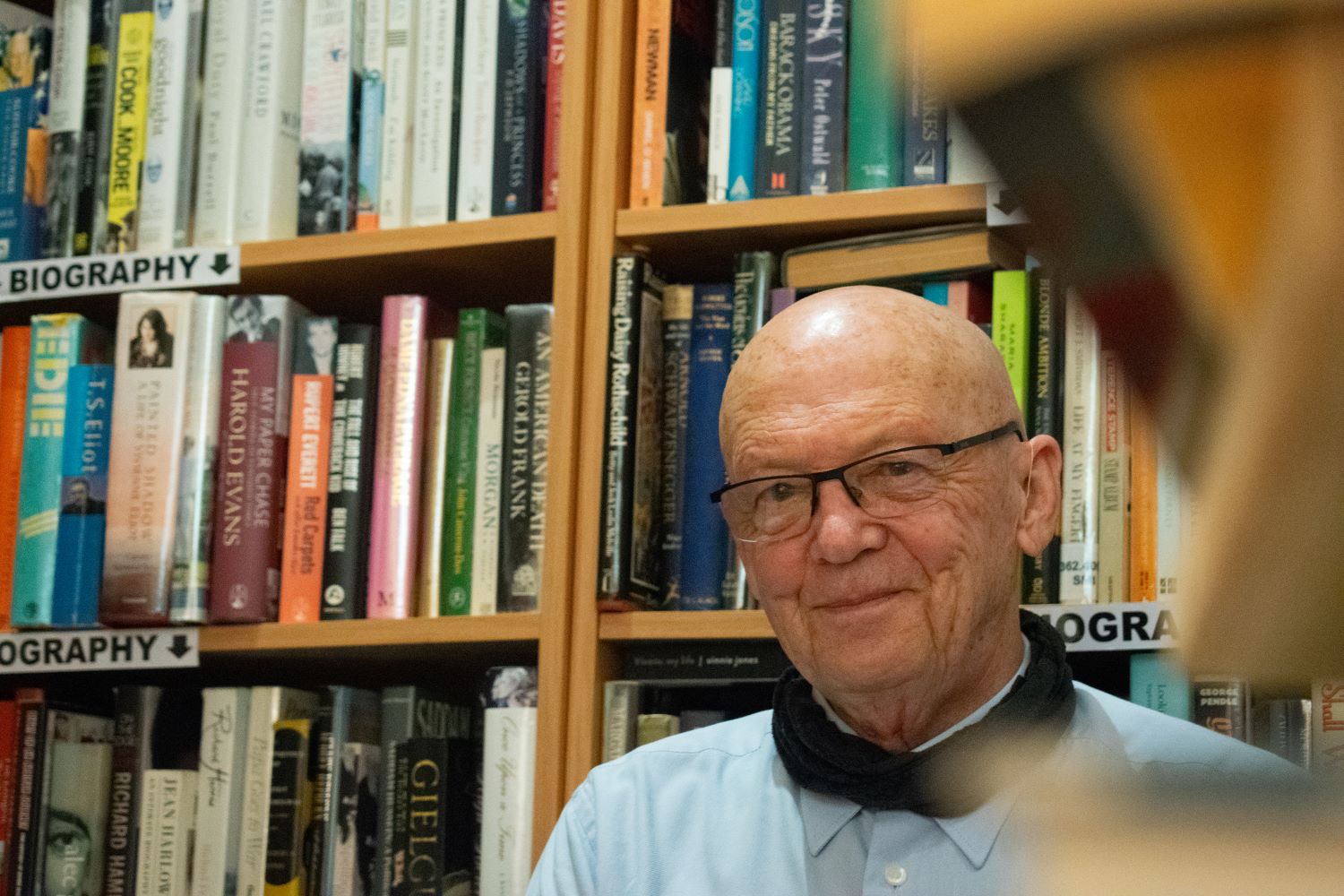
Chris Ormrod has run Paper Moon, a second-hand bookstore in Woodstock, Cape Town, with his wife, Dianne, for around eight years. PHOTO: Reid Donson
However, Ormrod, who is 81 years old, also recognises how much the world has changed.
“It’s a very different world we’re in,” says Ormrod. “But it’s also a very scary world, because cell phones are a part of [young people].”
He recalls an incident between a mother and her six-year-old daughter at the store.
“She just had a row with her mother outside. And she walked in, she put her hands on her hips, and she said: ‘You can’t do that! […] You can’t take my cell phone from me! It’s part of me!’,” he says. “What’s it going to be like when she’s 15 or 20? It’s big fun coming up, for sure.”
The Yondr system
GRAPHIC: Reid Donson
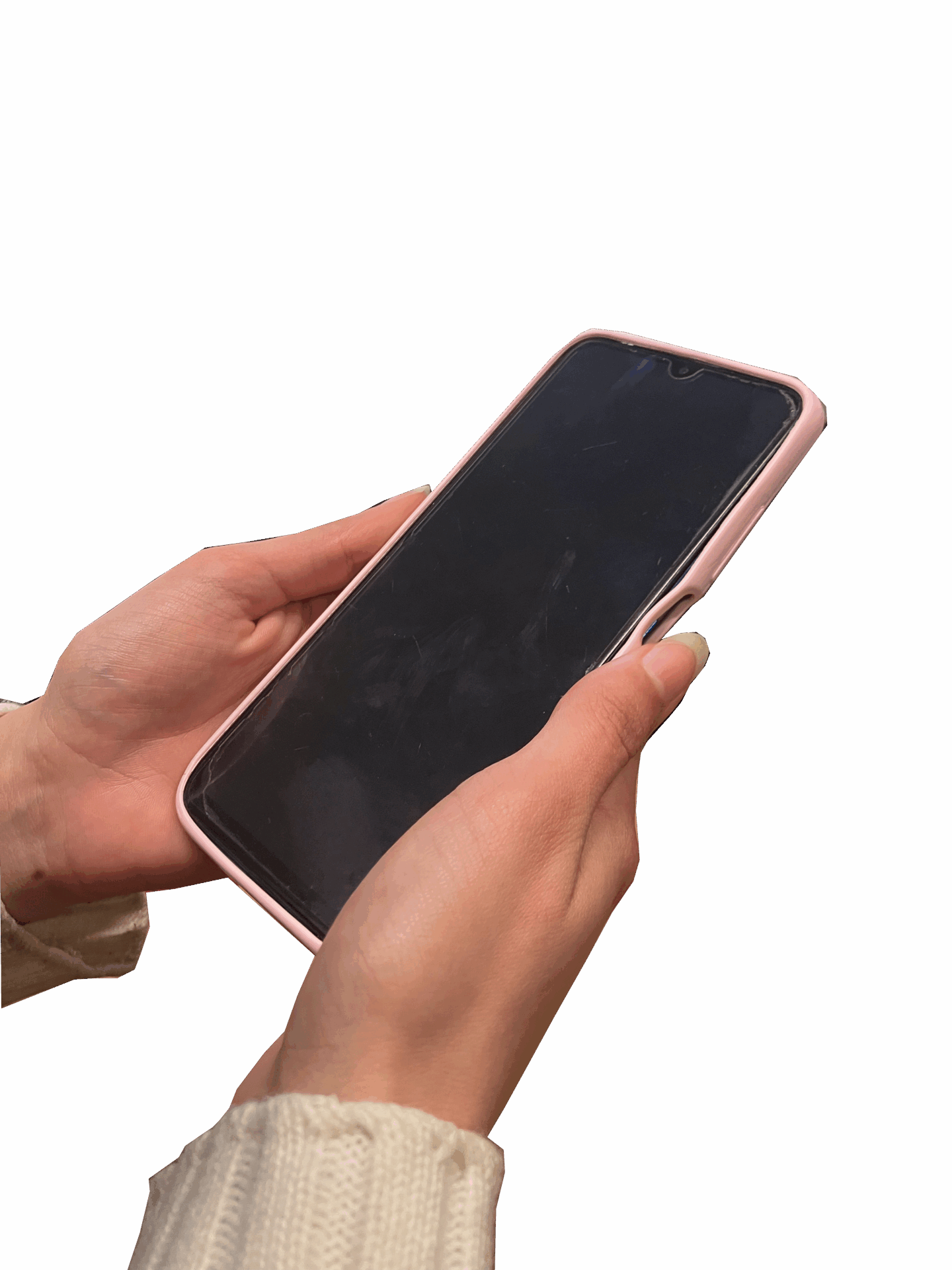
A local school recently decided to do something about its students’ overreliance on phones. South African College High School (SACS), an all-boys school in Newlands, Cape Town, implemented the Yondr pouch system at the beginning of the 2025 school year.
This is according to Chris Jones, deputy headmaster in charge of technology and education at the school.
“We needed to find a way of completely zeroing phones in the school,” he says.
When students enter their first tutor period of the day, they switch their phones off and place them in one of the pouches, which has a magnetised lock that stays activated until school hours end at 15:00, says Jones.
While the student keeps the pouch with him, the phone is inaccessible until the pouch is unlocked after school, he says.
“What we have seen is an interesting recurrence of old-school Rubik’s Cubes, cards, dominoes in some instances, ball games at break time… you know, hand tennis, that kind of thing,” says Jones. “It’s probably too early to say or to measure exactly the impact on academic output, but certainly I think the net effect is [that] the boys are far more attentive.”
‘Digital fatigue’
For Le Roux, attention is “a matter of motivation”: It is up to the individual to take active steps to improve their focus.
“Generally, when reading a book, people feel motivated to also look at their phones,” he says. “It’s not necessarily a case that they cannot [focus], it’s just a case that they choose not [to].”
Candice Ježek made the choice to shift away from digital in her career years ago. Ježek runs Dream Press, a home-based independent publisher just down the road from Paper Moon. Ježek, who started Dream Press in 2017, binds and assembles zines, graphic novels and art books by hand, which are then published.
Ježek uses a risograph printer, which is a special kind of stencil printing method.
“It’s a duplicator,” she says. “It has cylinder drums; ink drums that are very similar to the same process as silk screening. And I print one colour at a time.”
According to Ježek, one of her motivators for getting into hand bookbinding was digital fatigue.
“I was first a book designer,” she says. “And I got very bored […] of going and getting the stuff reproduced in a digital form, exactly how I saw it on screen. And glossy paper, and all the rest. And it felt dead, you know.”
This led Ježek to risograph printing and hand bookbinding.
“I see the book[s] as little sculptures,” says Ježek. “[I wanted] something that […] becomes this precious little object that [has] little misregistration and little quirks, and you can see that it’s done by hand because it’s not 100% perfect. You know, it’s not this glossy magazine, but something a little bit more original.”
Ježek also hosts zine workshops that help creatives design concepts and build upon their ideas.
“I think there’s been this slow rise in countercultures, [like] silent reading, […] there’s an interest in yoga, in meditation, in spiritual practices in general,” says Le Roux. “I think a lot of these small shifts are people realising that ‘the way my brain is working at the moment is suboptimal. It’s leading to negative emotional experiences and negative effects for me. And I want to change that’.”


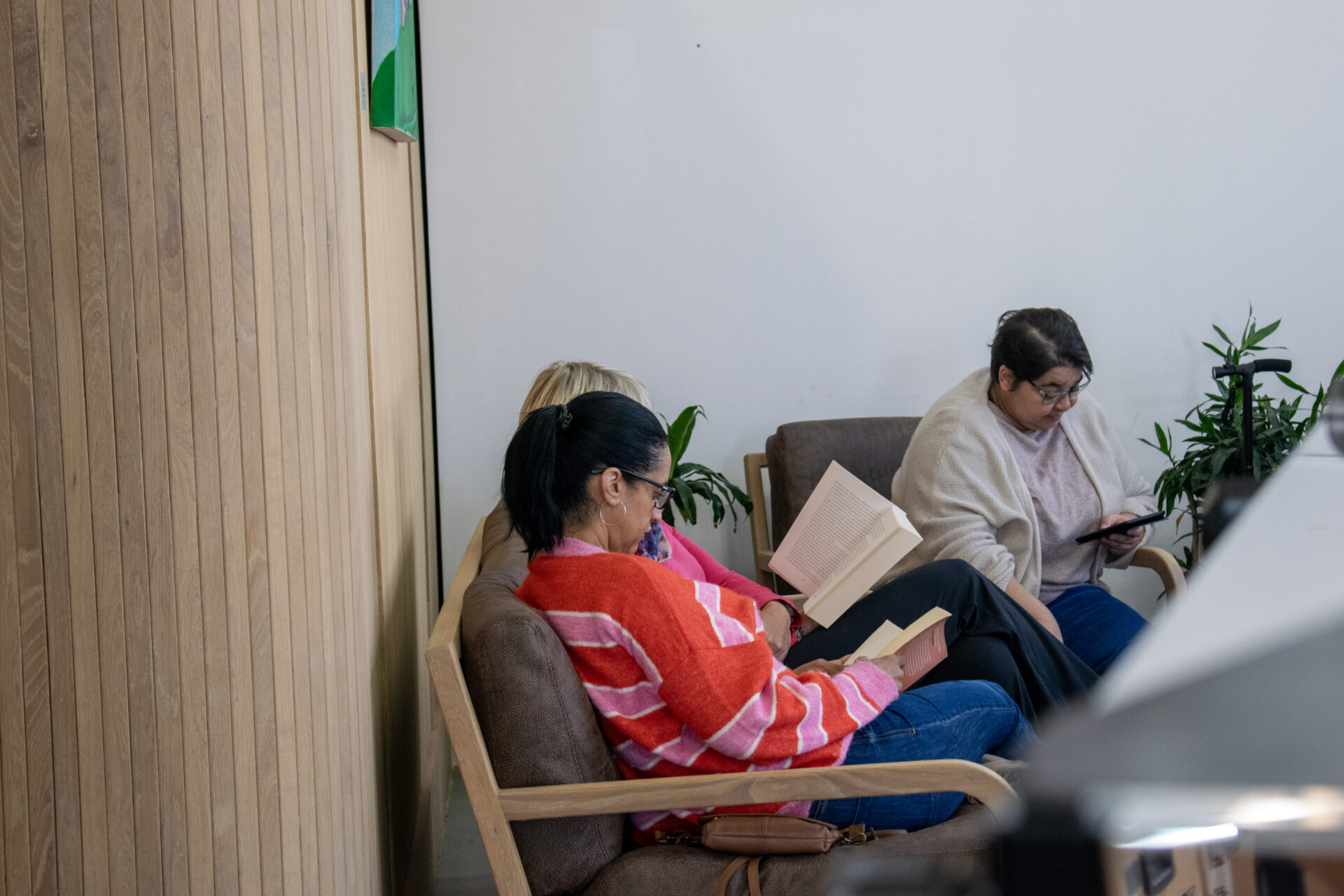
The La Marzocco showroom at the Old Biscuit Mill, where a group of people gathered for a silent book reading session on 3 August. PHOTOS: Reid Donson
“I think a lot of these small shifts are people realising that ‘the way my brain is working at the moment is suboptimal’.”
Back at La Marzocco, a voice breaks the concentration in the room.
Buck announces to the 146 people gathered at the showroom that the hour of reading is now up. As suddenly as it entered, the silence leaves the room. People scuffle towards the door, while others make small talk and order coffee. Outside, life is as loud as ever.
But some people keep reading.
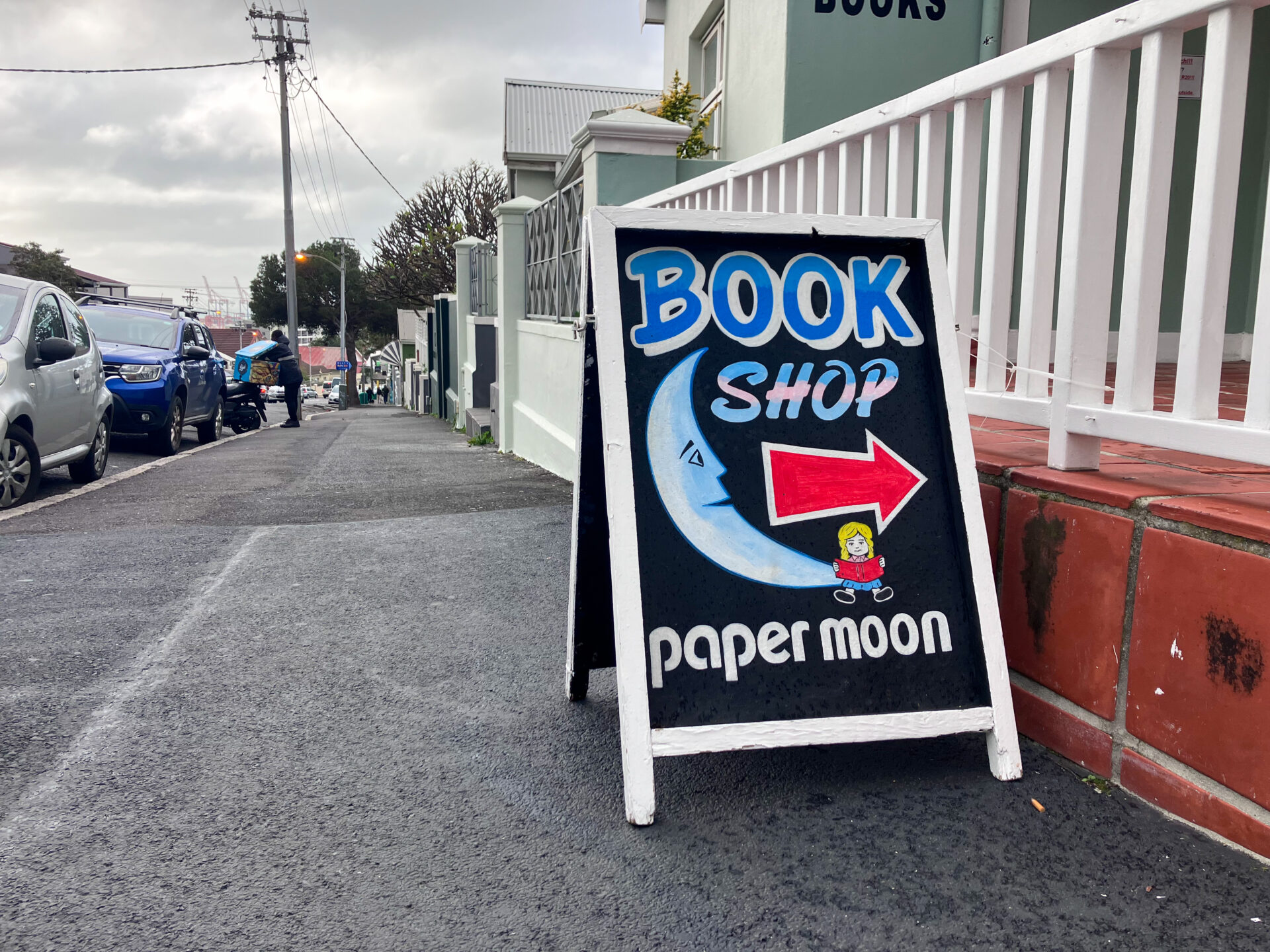
Chris Ormrod, who co-owns Paper Moon with his wife, Dianne, says that he gets to meet a wide variety of people through his bookstore. “I promise you, we can’t wait to open up in the morning,” he says. “It’s almost like a kind of therapy […] you don’t know who’s going to come in the next day.” PHOTO: Reid Donson