
Pedalling towards accessibility
Cycling is an environmentally-friendly form of commute or exercise. As a sporting activity however, it remains unaffordable for the majority of South Africans. A handful of organisations throughout the country are working towards making cycling accessible to all.

Tendani Tshauambea began cycling as a hobby in 2022 when he was 23 years old.
He describes the joy he finds in cycling, stating his belief in the collective responsibility that society holds in encouraging more people to cycle.
“It’s a lovely sport, but I think we can do more as a society to encourage more individuals from poorer backgrounds [and] working class backgrounds to be able to access the benefits of [cycling],” says Tshauambea. “I think that for me is the most important thing.”
He is currently completing a BAHons (English Studies) at Stellenbosch University (SU), where he continues to participate in initiatives aimed at making cycling more accessible to students.
With cycling, it’s not only about buying the bicycle – one also has to invest in cycling equipment, bicycle gear and dietary requirements, says Tshauambea. One also has to have the ability to do it in an adequate way so as to benefit the individual.
Tendani Tshauambea shares his cycling journey, which first began as a hobby in 2022 when he was 23 years old. VIDEO: Kuhle Tshabalala
There’s levels to this
In most European countries, cycling is considered to be a cheap, easily accessible and a sustainable mode of transport. Therefore, many Europeans can pursue cycling as a sport and participate in a variety of cycling tournaments and training opportunities.
This is according to Dr Claire Walker, sport scientist and lecturer at SU.
Across the European Union (EU), 29% of people reported that they cycled at least once a week, according to an article published by Euro News.
However, in South Africa, although some people have the ability to use bicycles as a form of transport to and from work, cycling is not yet at a point where it can be considered a “norm”, says Walker.
In other words, a large portion of South Africans are not at the point where they are able to advance cycling from just being a form of transport into a leisure activity, she says.
This is due to expensive cycling equipment, including, but not limited to the bicycle, helmet, shoes and a front and rear light necessary for cycling to work during dark hours or in the winter, says Walker.
Other factors include limited skills training and unsafe infrastructure such as the lack of cycle lanes or even a road shoulder (the portion of the road used for stopping or emergencies) across most parts of South Africa, according to Walker.
“In particular, the fear of fast-moving and unpredictable traffic and very few cycling lanes make cycling on the road very stressful which is a significant contributor to limited participation,” says Walker.
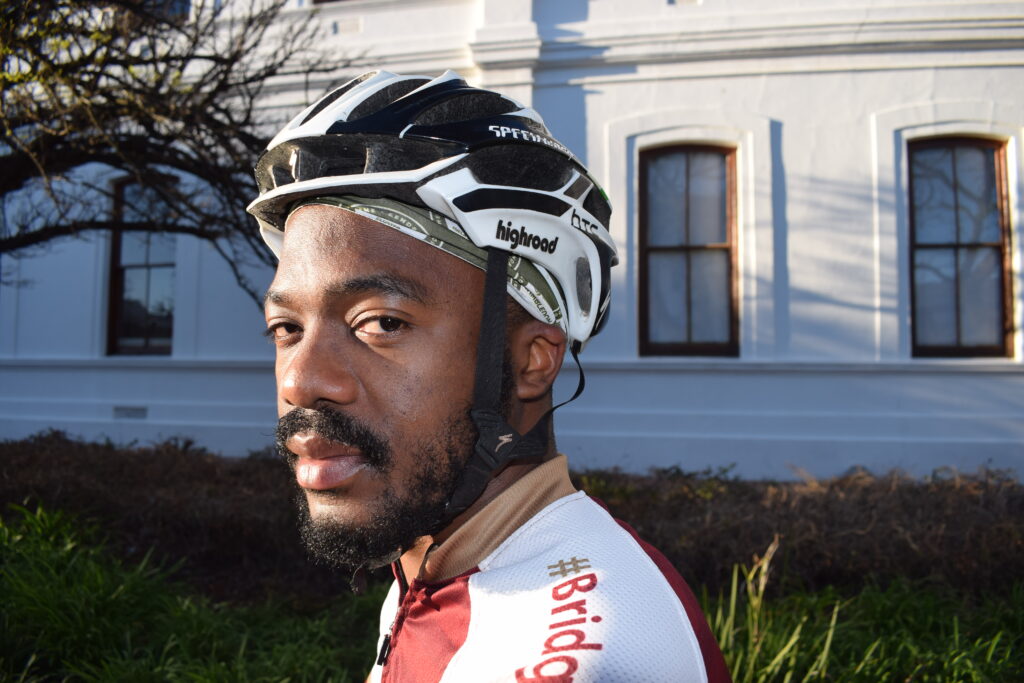
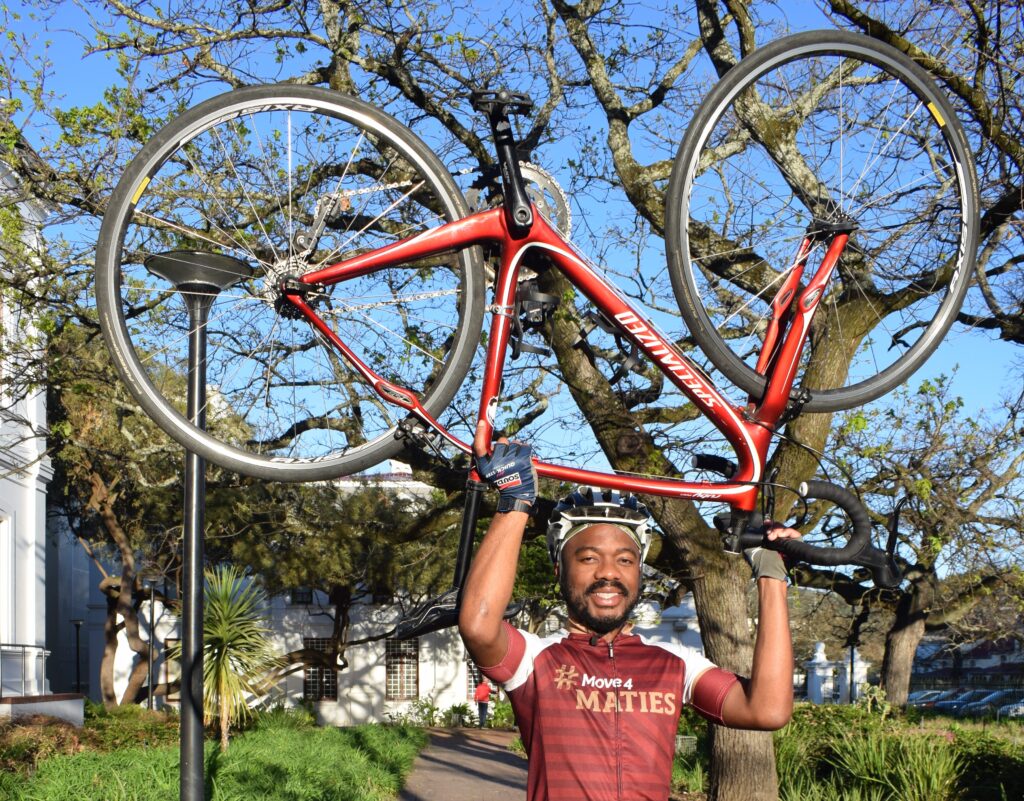
Tendani Tshauambea believes that society holds a collective responsibility to encourage more people to cycle. PHOTOS: Kuhle Tshabalala
Back to basics
When it comes to participating in cycling at a professional level, cyclists should start with the basics first, says Slovenian cycling champion, Peter Vesel, who has finished the Cape Epic mountain bike stage race seven times. The Cape Epic is “a physically gruelling and mentally demanding mountain bike stage race […] hosted in South Africa’s Western Cape region”, according to its website.
One can enter into cycling as a sport with a relatively inexpensive bike, however, as cycling skills and fitness improve, cyclists look to start competing in races, says Vesel.
“[This] of course comes with significant costs [so] it’s essential to make a financial plan before each season,” says Vesel, on the cost of cycling competitively.
For instance, South African participants have to pay an entry fee of around R120 000 per team of two cyclists to participate in the Cape Epic mountain bike stage race, according to the website. Each standard entry includes tented accommodation, recovery meals, medical services and bike services, according to the website.
The prices of bicycles remain one of the key hurdles to accessibility. This is according to Sindile Mavundla, the founder and managing director at Khaltsha Cycles, a Khayelitsha-based bike shop offering affordable bicycle brands.
“One of the biggest issues is that bicycles are expensive,” says Mavundla. “What we have done at Khaltsha Cycles is to really make bicycles less expensive […] you can pick up a bicycle from our bike shop at around R1500.”
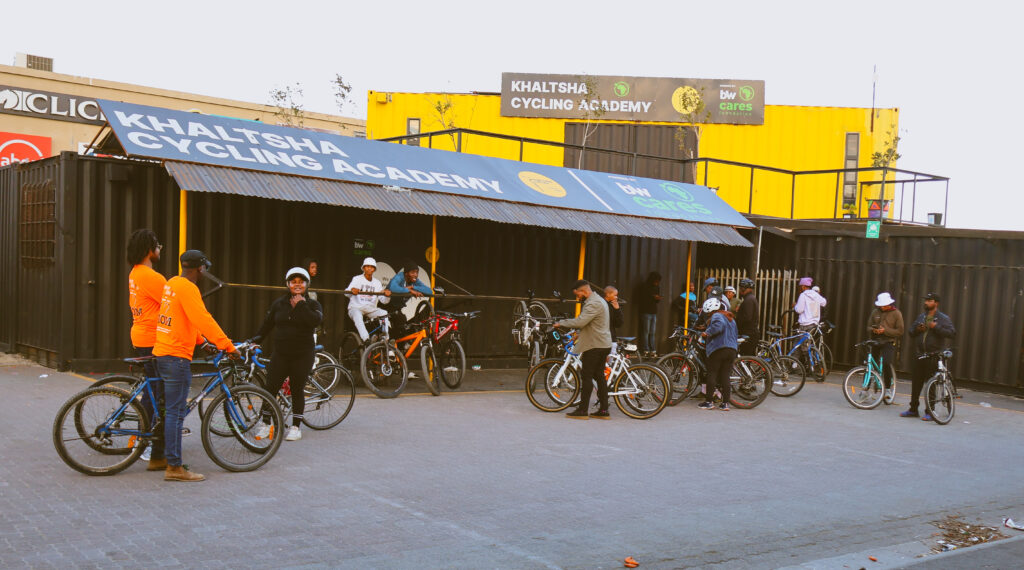
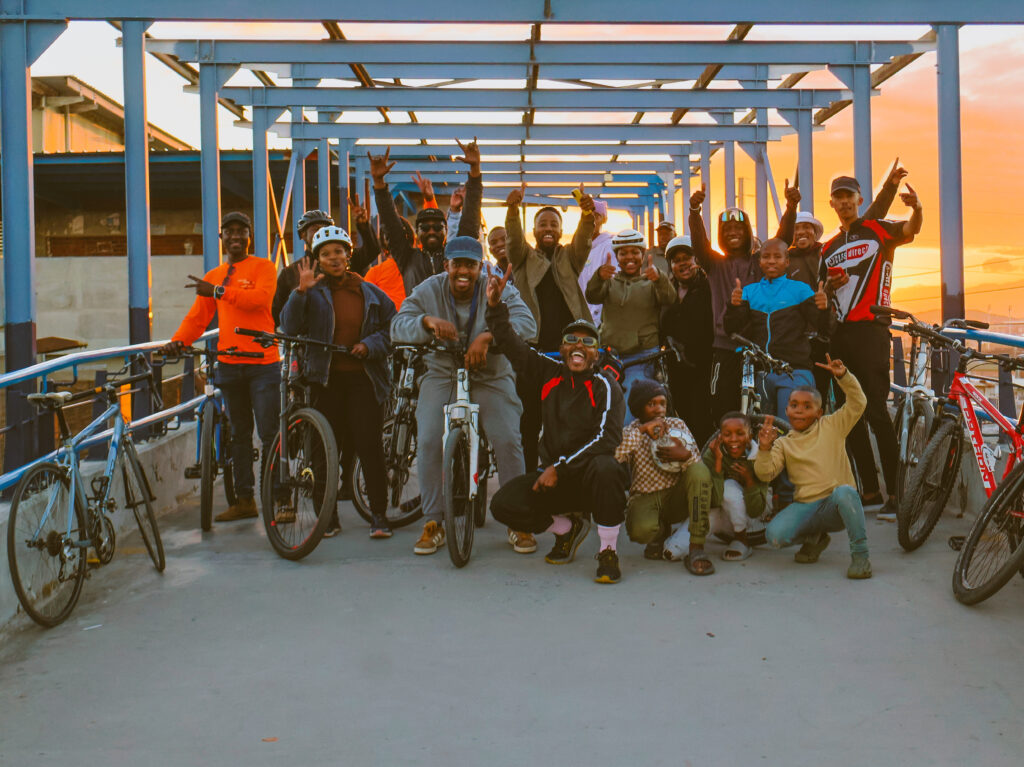
Khaltsha Cycles remains the only bicycle shop in Khayelitsha, claims Sindile Mavundla, the founder and managing director at Khaltsha Cycles. PHOTOS: Supplied/Khaltsha Cycles
The cost of bikes used in competitions start from R6200, says Mavundla.
Khaltsha Cycles has partnered with the Bicycling Empowerment Network, which brings in recycled bicycles from overseas, says Mavundla. Their team then improves the condition of these bicycles and resells them to their customer base in and outside of Khayelitsha, he says.
Furthermore, Khaltsha Cycles allows customers to have lay-by options for payments as well as stocking pre-owned bikes, making it affordable for everyone, according to Mavundla.
“We’re just giving people the ability to buy their bicycle without the financial pressure, so they can actually pay [for] their bicycle over a three month period, and they’re able to actually afford a bicycle,” says Mavundla.
Khaltsha Cycles has also been running a cycling academy for women and girls since 2022, says Mavundla.
“The whole mission of the academy is to empower women and girls on and off the bike, through a series of programs that we run, [namely] educational support, […] cycling […] mentorship [and] self-development,” he says.
GRAPHIC: Kuhle Tshabalala and Anke Spies
The academy particularly focuses on young women in grades eight to ten, also providing them with educational support, says Mavundla.
The young women attending the academy have completed well-known races such as the Cape Town cycle tour, Wines2Whales and the Old Hermon Gravel Ride, with one of them winning the latter, says Mavundla. He adds that she went on to participate at the Tour de France recently.
“Khaltsha Cycles is still the only bicycle shop in Khayelitsha […]. I’ve always been annoyed by the fact that there’s no bicycle shop in Khayelitsha,” according to Mavundla. “The majority of us who have bikes had to go outside of Khayelitsha to service our bicycles. So, then I started the bike shop in 2017.”
Khaltsha Cycles has developed a strong cycling community in Khayelitsha, organising social events where individuals get the opportunity to practice their cycling skills, says Juma Mkwela, co-founder and operations manager at Khaltsha Cycles.
“Khaltsha Cycles is still the only bicycle shop in Khayelitsha.”
“Our first [ever] customer, who is in his 70s, is a plumber,” says Mkwela. “He is still riding his bicycle today, doing plumbing around Khayelitsha.”
However, accompanying infrastructure, such as cycling lanes, is continually lacking in Khayelitsha, says Mkwela.
“We still have a challenge where we are cycling next to cars,” says Mkwela. “Some people want to buy a bicycle, but they always say ‘I’m scared to ride on the road’.”
The taxi industry has been supportive in this regard, according to Mavundla. “The taxi industry has been one of the industries that has really been respecting us as cyclists in Khayelitsha […]. They give us right of way, especially if you’re riding in a group.”
Specialized cycling
The Specialized foundation, now known as Outride, focuses on the empowerment of the youth and communities through cycling, partnering with initiatives such as the Songo.info foundation to reduce barriers of entry into the sport.
This is according to Sipho Madolo, programme manager of Songo.info foundation, a social development programme in the Stellenbosch community of Kayamandi.
“Outride combines research, school-based programs and community grants of up to R262 000 to support well-being and equity through cycling,” says Madolo.
According to Madolo, Songo.info has been able to take many attendees to a national level. One such example is Ovayo Ntsenge, who won the South African BMX championships last year in his category, says Madolo.
Winning the championship was a life-changing experience, says Ntsenge.
“Support from organisations like Songo is necessary,” says Ntsenge. “It empowers cyclists [from] disadvantaged backgrounds by providing access to […] resources, mentorship and opportunities, helping level the playing field in competitive cycling.”
Beyond exercise
When examining the topic of reducing barriers to cycling, it is important to consider the role of sports science and how it provides a foundation for evidence-based approaches to cycling promotion, says Walker.
“As a discipline and through the larger industry as a whole, sport scientists demonstrate the physical and psychological benefits of cycling through research and evaluation,” she says.
Cycling offers many benefits when it comes to physical and mental health, says Africa.
“Cycling is proven to reduce stress and anxiety by releasing mood-lifting chemicals in the brain, while the pride of mastering a new skill builds lasting confidence and self-esteem. Beyond the individual benefits, a bike ride also creates cherished opportunities for social connection and family bonding, making it a fun and easy way for kids to get their daily dose of activity,” says Africa.

Sports scientists are well-placed to make use of health and performance information in promoting cycling, good health and sustainability, says Walker.
“From a practical point of view, sport scientists can help individuals see the health benefits of cycling, such as improved cardiovascular systems, better fitness levels and more energy for their daily activities,” says Walker. “Taking it further, they can use performance data such as distance and speed cycled or energy burned to set realistic goals for active commuting.”
Children and adults are encouraged to engage in at least 60 minutes of physical activity each day to elevate the heart rate and increase breathing, according to Africa.
“By combining insights on health, performance and accessibility, sport scientists help turn research into real-world practice,” says Walker, stating that it is important to make sure that sport scientists are part of the structuring of initiatives so that they can be both effective and inclusive.
“Cycling goes beyond exercise – it builds independence, confidence and encourages lifelong healthy habits, while making movement an enjoyable part of daily life,” says Africa.
Pedalling forward
Cycling requires one to invest in a bike, which is the largest investment, according to Tiffany Keep, South African Olympic cycling champion and elite women’s national team member. In addition to this, there is also costly equipment such as shoes, a helmet and other kit. All of this makes cycling a comparatively difficult sport to access, says Keep.
“As the financial barrier is one of the biggest barriers of entry to the sport, reducing the cost of starting up and creating a more accessible avenue into the sport will most certainly result in a higher participation in the competitive sphere,” she says.
One could choose the option of borrowing equipment, but, even then, the sport is not as accessible as other sports such as running, says Keep.
In May of 2025, the SU transport department introduced the Operation Maties Bikes initiative to repurpose redundant bicycles from the department during its bicycle fleet renewal, according to Colleen Charters, administrative officer for the vice-dean of clinical services and social impact at SU.
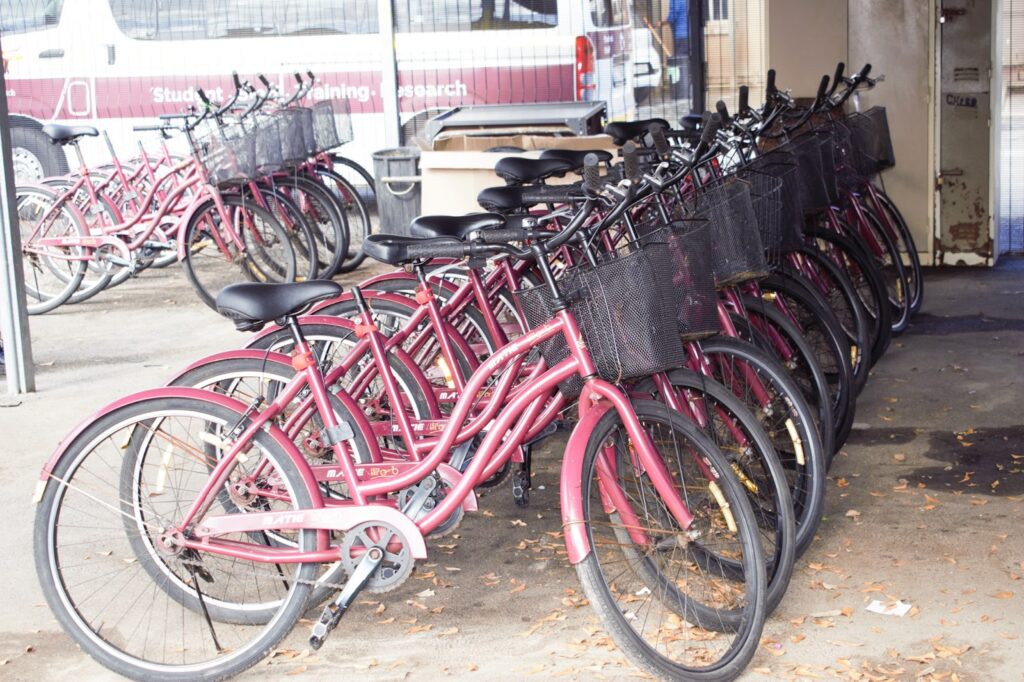
Bicycles lined up for the Operation Maties Bikes initiative. PHOTO: Aubrey Phungo
Through the initiative, 150 bicycles have been donated to schools in rural areas, enabling learners to take part in school activities and extracurricular programmes, says Charters. Elsewhere, community healthcare workers are able to gain the ability to service more centres and keep regular contact with their community, says Charters.
The initiative had various participants, including the Worcester R.C Primary School, Esselenpark Senior Secondary School, and non-governmental organisations (NGOs) working with the Western Cape department of health and SU students at rural training sites.
A key component of Operation Maties Bikes is the Pedal Forward project, which incorporates the use of bicycles into daily school activities, while promoting regular physical exercise and nurturing learner independence. This is according to Professor Eileen Africa, head of teaching and learning and kinderkinetics coordinator at the division of Movement Science and Exercise Therapy (MSET) at SU.
The Pedal Forward project is an example of an initiative giving people more access to the sport, from athletes aiming to cycle competitively to those whose daily commutes rely on bicycles, says Keep.
According to Walker, embedding cycling within local communities will help in normalising it as an inclusive, everyday activity or transportation tool, instead of a niche sport.
GRAPHIC: Kuhle Tshabalala and Anke Spies