
IS YOUR CAR SLOWING YOU DOWN?
GRAPHIC: Kobus Erasmus
On a typical weekday, during rush hour, there is virtually no movement of cars in Stellenbosch’s central business district. Hilux bakkies, Range Rovers and Fortuners sit bumper-to-bumper for the better half of an hour just to get out of town. At a car’s rate of movement in this timeframe, a bicycle will easily outpace even the shiniest of sports cars.
Stellenbosch is a historical town with a colonial history that dates back to the 17th century. The town’s age is evident in its urban design, where an irregular grid emerged organically as the population grew, according to the Stellenbosch Heritage Foundation website. Narrow roads are further constricted by parallel parking bays, which often line both sides of the road.
But Stellenbosch is also one of the most walkable cities in the country. So, why is it that residents stick to their cars?
Stellenbosch has a problem: Too many cars in the central business district (CBD), and too little physical space to accommodate most of them. This is a sentiment held by Dr Dave Pepler, ecologist and retired TV-personality. Pepler, now 75 years old, has been cycling since his childhood in the Karoo. More than half a century later, he sits down with SMF to discuss his lifelong love for cycling.
“For me, cycling is about freedom and environmental awareness,” says Pepler, who has lived in Stellenbosch since the 1970s.
“In other words, when I ride home, I know who buys biryani, whose orange trees are blooming, where dangerous dogs are, and where I need to shout terrifying curses when people drive too close to me,” he says.
He is meeting with SMF at a café in the heart of Stellenbosch. A bicycle lock lies on the table next to a half-empty cortado. It’s a chilly Friday in August, and a leather jacket-clad Pepler is in no particular mood to hold back his opinions.
“That is what irritates me intensely about Stellenbosch, because, remember, I’ve been living in the town since the first of May 1974,” he says. “[Stellenbosch locals] are bewitched by what is surface-level.”
Pepler, however, is captivated by real simplicity, such as the efficiency of a bicycle. It is the most effective means of transport on Earth, he says.
He also has a gripe with the town that he has called home since the 70s.
“The only problem is that some people consciously try to run you over. You know, they feel fokkol. They actually aim for you,” he says, about commuting by bicycle.
“When you try to navigate through this town after four, on a normal weekday, with the university in session, I ride four times faster on my bicycle [than the cars stuck in traffic],” Pepler says. “The whole […] town is simply constipated and completely gridlocked with cars, each with just one person inside. It’s insane.”
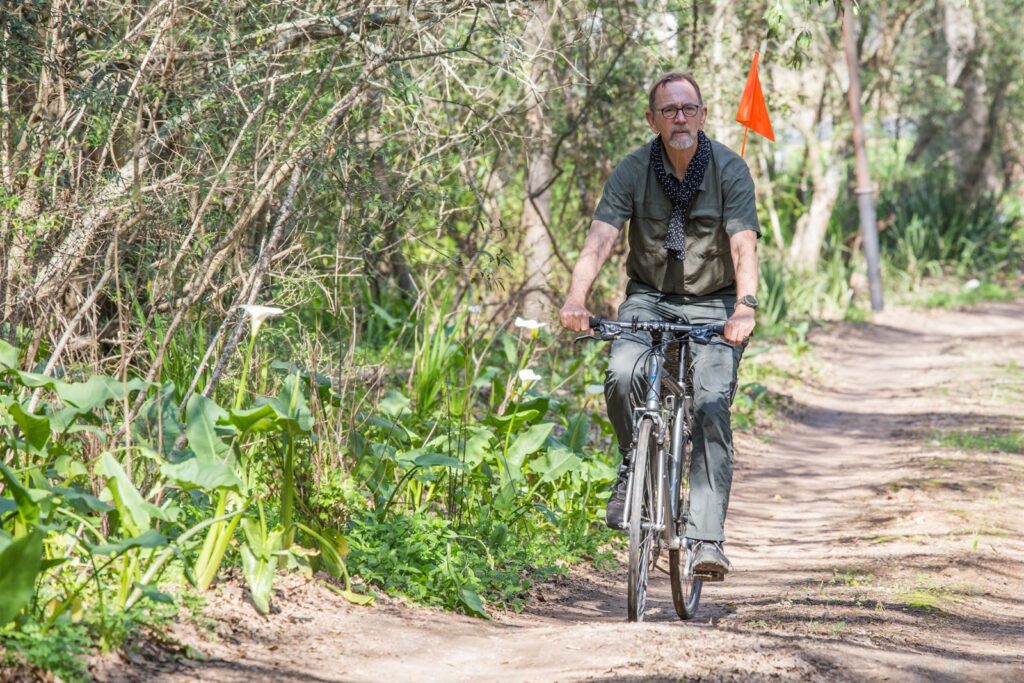
“When I ride home, I know who buys biryani, whose orange trees are blooming, where dangerous dogs are, and where I need to shout terrifying curses when people drive too close to me,” says Dave Pepler, an ecologist and a retired TV-personality. PHOTO: Supplied/Dave Pepler
‘Stellenbosch is stuck’
“Stellenbosch definitely has a problem with congested roads and too little parking, due to an oversupply of vehicles in the town,” says Dawid Botha, chairperson of non-profit organisation Stellenbosch Cycling.
Stellenbosch Cycling promotes cycling as a means of transportation, recreation and exercise amongst all communities in the greater Stellenbosch area, says Botha.
Cycling, as an alternative mode of transportation, might alleviate some of Stellenbosch’s traffic problems, says Roland Postma, managing director of the non-profit company (NPC) Young Urbanists South Africa.
For the past few years, Postma and his NPC have been advocating for a change in how people navigate urban environments in South African cities.
“Young Urbanists is a South African civil society platform for open dialogue, engagement, and action to undo the spatial, social and environmental injustices left by apartheid city planning,” says Postma. He explains that they want to re-engineer existing neighbourhoods into inclusive, mixed-income neighbourhoods, which will be safe and vibrant public spaces.
In May 2025, Young Urbanists organised and hosted a meeting for Stellenbosch residents to discuss ideas to resolve traffic congestion. The meeting, aptly called ‘Stellenbosch is stuck’, saw participants discussing potential solutions ranging from formalised minibus schedules to safer walking and cycling infrastructures.
“Stellenbosch has both the policy tools and funding necessary to tackle congestion – the real challenge is collaboration and execution,” Postma says.
Young Urbanists is currently running its Bree Street Safe Passage pilot in Cape Town, together with the City of Cape Town. This barrier prevents cars from occupying the Bree Street cycling lane.
“These are the types of low-cost, high-impact measures Stellenbosch could adopt immediately, with measurable results,” says Postma. “If Cape Town can integrate these kinds of solutions into its mobility planning, Stellenbosch can too.”
It is important to note that these solutions are not hypothetical, but already exist within Stellenbosch’s own policy framework, according to Postma.
“What is deeply concerning is that, instead of fast-tracking these already-approved interventions, the municipality is advancing the controversial Eikestad parking garage proposal,” he claims.
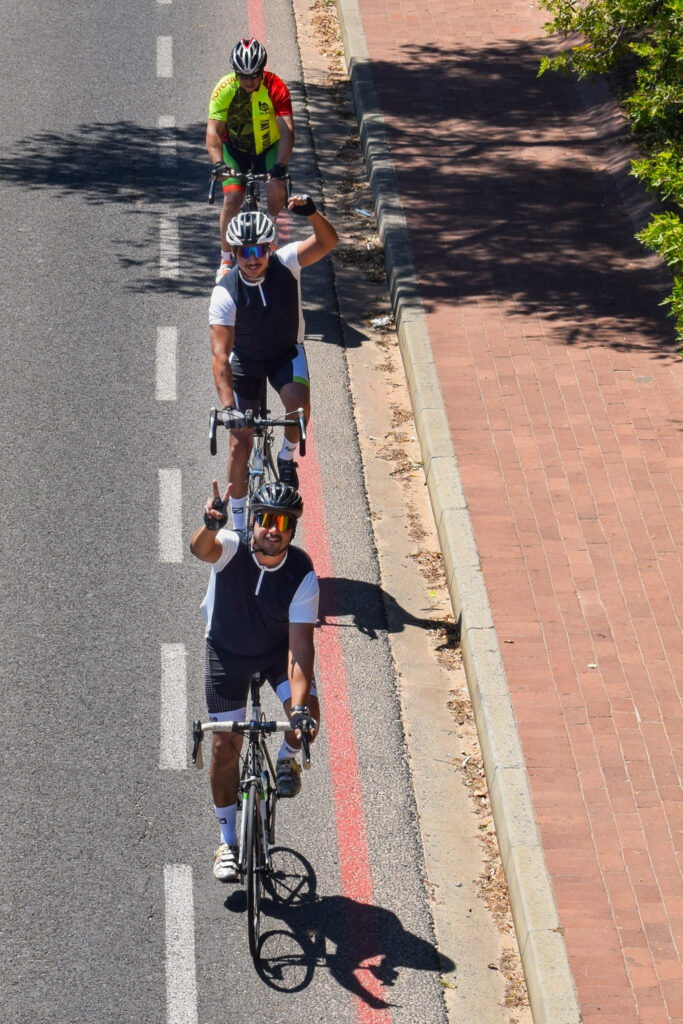
Merriman Avenue is one of the few streets with a dedicated cycling lane in central Stellenbosch. PHOTO: Kobus Erasmus
The parking garage debate
In 2022, Stellenbosch Municipality proposed to lease out the Eikestad parking area to Eikestad Mall. In the following year, the municipality made a recommendation to build a multi-storey parking facility on the grounds.
Official approval for the proposed parking garage has not yet been granted by the Stellenbosch council, according to Stuart Grobbelaar, communications manager for Stellenbosch Municipality.
“The current reality is that drivers often spend considerable time circling the CBD in search of parking, which, in turn, worsens congestion,” says Grobbelaar.
“While cycling is an excellent mode of transport for some, it is not a practical solution for many visitors, workers or tourists who travel from further afield,” he says.
On 20 February 2024, Young Urbanists created a change.org petition opposing the proposed three-storey parking garage in central Stellenbosch. The petition was released alongside a joint statement from Young Urbanists, Active Mobility Forum and Stellenbosch Cycling.
Approximately 3 500 participants rejected the proposed parking garage, according to Postma. “It prioritises putting more cars into the CBD rather than intercepting them before they enter, which is the exact opposite of the congestion-reduction strategy the municipality itself has committed to,” he says.
If Stellenbosch wanted to solve its traffic problem, the municipality should stop investing political and financial capital into car-dependent projects and start implementing solutions that already exist on paper, says Postma.
According to Botha, the more vehicles there are in the town, the more dangerous it becomes for cyclists.
“The municipality’s goal [set out] in the Comprehensive Integrated Traffic Plan (CITP) and in the Integrated Development Plan (IDP) is a ‘car-free CBD’ – a vehicle-free town centre,” he says. These municipal plans date back to 2022.
Further, the municipality’s non-motorised transport (NMT) Masterplan “strives towards car-free living in the Stellenbosch CBD”, according to Botha.
The CITP is intended to develop, manage, integrate and provide for all modes of transport in all areas of Stellenbosch Municipality’s jurisdiction, according to Grobbelaar.
“This includes planning for the role of non-motorised forms of transport, such as walking and cycling,” says Grobbelaar. “[These policies encourage] sustainable modes of transport such as public transport and increased numbers of passengers per vehicle.”
“What is the answer? Parking lots or garages on the edge of town with shuttle services to the town centre,” says Botha. Stellenbosch Cycling proposes that the municipality invests in park-and-ride services instead of the Eikestad parking garage.
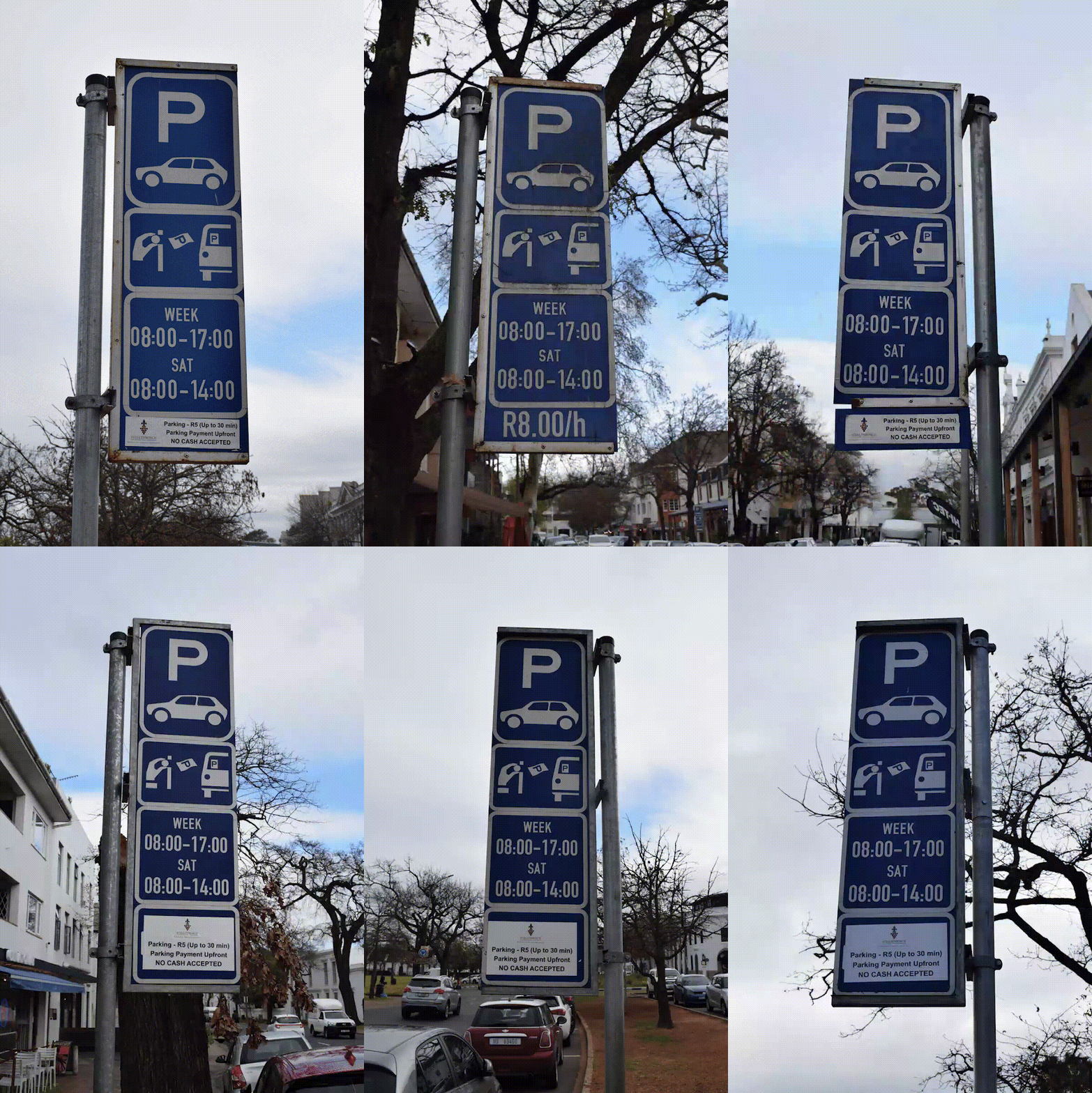
There are a plethora of parking spots in the Stellenbosch central business district, with far fewer dedicated places to lock-up bicycles, SMF noted. GIF: Kobus Erasmus
A matter of infrastructure?
While bicycle theft is still a relevant issue in Stellenbosch, its prominence has lessened in recent years. This is according to Martin Viljoen, Stellenbosch University (SU) spokesperson.
“Data shows that bicycles locked with […] cheap locks are most targeted. The use of bicycle sheds on campus, raising awareness of bicycle thefts and/or arrests of bicycle thieves are having a positive impact [on the prominence of bicycle theft],” says Viljoen, in correspondence with SMF.
“Bicycle theft is a real thing. My bicycle has never been stolen; I have a high security lock,” says Anouk Cronjé, a Stellenbosch local that regularly commutes on her bicycle. “But I have lost a pump and two bicycle lights [to theft]. People will steal things from your bicycle.”
SU has its own bicycle programme, which sees 100 to 150 bicycles being rented out to students every year, according to Viljoen.
Through the programme, older bicycles are donated to various rural communities to provide a mode of transport, connecting individuals with places of education and healthcare.
“The [university transportation services] are also working closely with groups such as Stellenbosch Cycling and the municipality to develop safer and better cycling lanes,” says Viljoen. “This is, for example, part of the planning of new projects, including the upgrading of the sidewalks in Victoria Street.”
“Stellenbosch does not have nearly enough access to cycling infrastructure. I am riding on the sidewalk most of the time,” says Pepler.
Despite not having an abundance of cycling infrastructure, Stellenbosch remains appealing to bicycle commuters, according to Cronjé.
“For me, it’s better than cycling in Wellington, which is my hometown,” says Cronjé. “But not quite as nice as cycling in Cape Town, which has sectioned-off cycling lanes with barriers.”

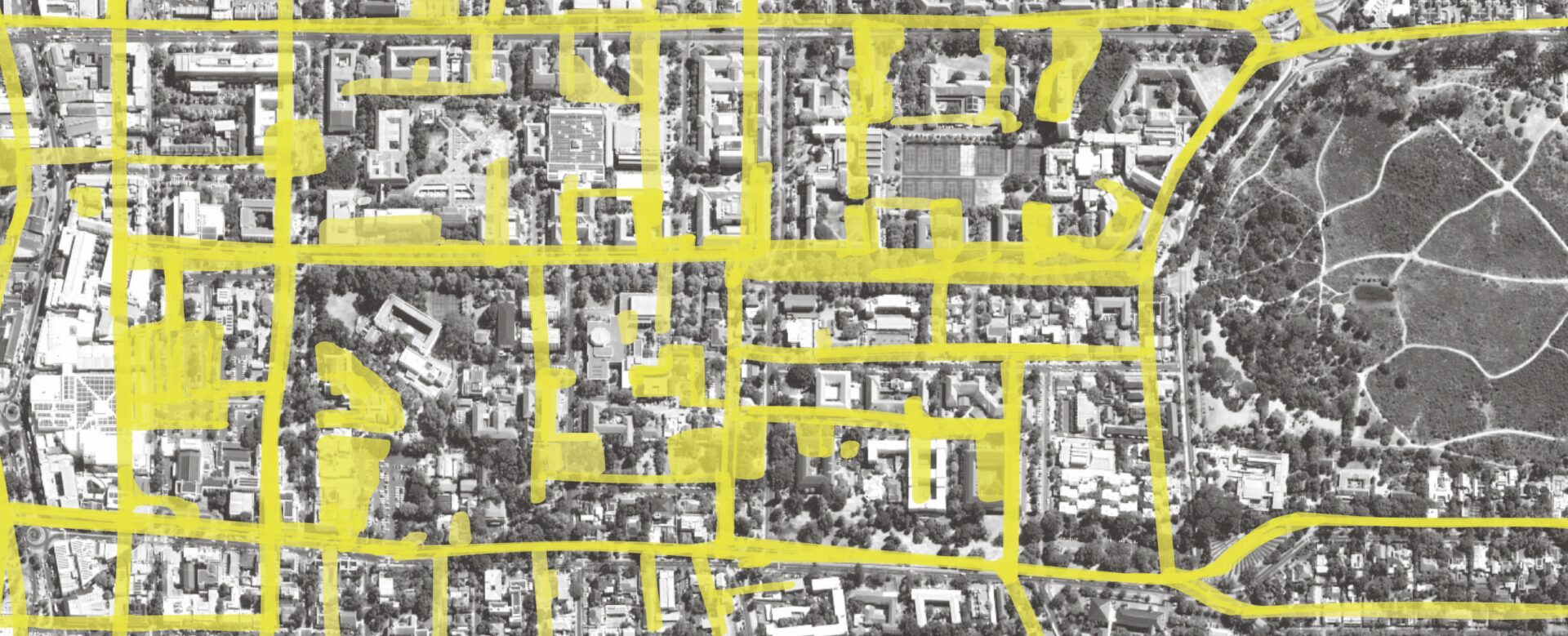
SMF has compiled a map contrasting car-focused infrastructure (in yellow) with cycling lane infrastructure (in orange) in the Stellenbosch central business district. GRAPHIC: Kobus Erasmus