Another brick
in the wall
What defines a town’s character? Is it how it grows and progresses, or the quiet pillars of consistency which sustain it? Stellenbosch is characterised as much by its hodgepodge of concrete student flats and Cape Dutch style gables as by the diverse people who call it home. However, some believe the town’s architectural heart to be under threat in the face of continuous student developments.
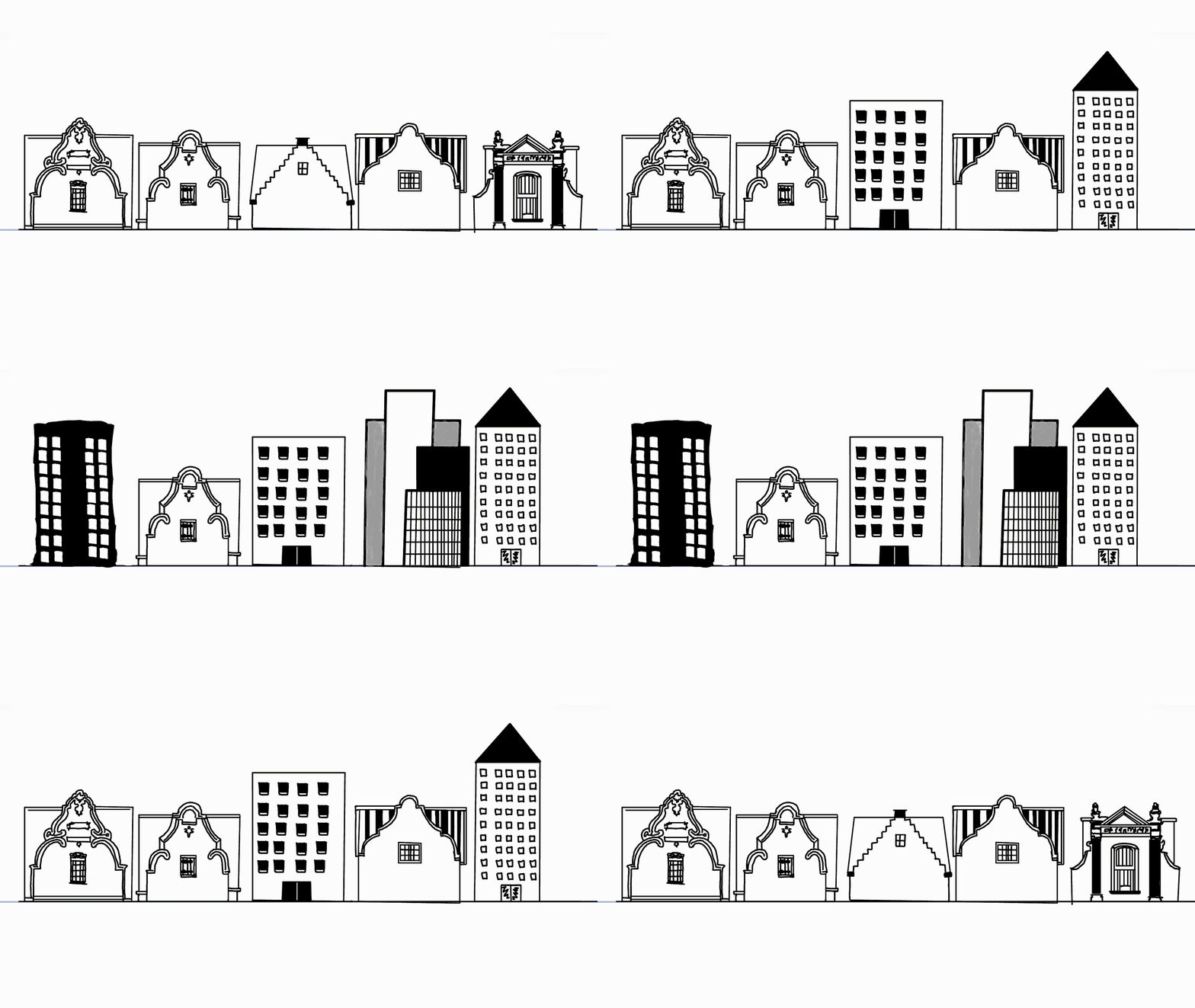
GIF: Kiara Wales
Beginning with a little island in the middle of the Eerste River in 1679, Simon van der Stel laid the foundations for South Africa’s second-oldest colonial town. On that river’s floodplain in 1886, the cornerstone of the Ou Hoofgebou (Old Main Building) was laid. So began what is now recognised as Stellenbosch University (SU).
This is according to Karlien Breedt, senior archivist at the SU Archives, who describes the parallel, sometimes interweaving, growth of the town and the university.
Fast-forward to the 21st century, and Dr Jolanda Morkel, vice-chairperson of the Stellenbosch Heritage Foundation, believes the architectural heart of this “wonderful tranquil Boland village” to be under threat.
“There is not enough dialogue between the university, municipality, [Stellenbosch] Ratepayers Association and interest groups in Stellenbosch in finding a way that its ecosystem can flourish,” she says.
Foundations and furniture
In 1975, the Stellenbosch neighbourhood of Simonswyk, located just over a kilometre from SU, was home to permanent residents.
The university’s population sat at less than 10 000 students at the time, according to the 1975 SU rector’s report.
Dr Pieter and Annemarie Maritz moved into the neighbourhood to find themselves surrounded by other families. Half a century later, “this has changed”, Annemarie says. “There are no families here anymore.”
Pieter reflects on how they have watched their surroundings change over the past 50 years.
“A few houses […] had losieshuisregte [boarding rights] – they were allowed to have up to four students,” he says, referring to the nature of Simonswyk in the 1970s.
From there, he describes how the houses around them became occupied by six students, then seven, until almost every house was filled.
Buildings were either bought by developers to create “made-for-student” housing’ or homeowners sold or rented out their homes to students as a form of income, with long-time residents moving out themselves, he says.
As of 13 February 2025, more than 31 500 students had registered for SU’s 2025 academic year, according to the university’s official website.
Students’ buying power shaping this old town is not a new idea, however.
This is according to Jan van Rensburg, a town planner at TV3 Architects and Town Planners. He says that the firm has worked on SU-related projects on a weekly basis since its inception 34 years ago.
Much change of ownership took place in the 20th century, with townspeople donating or offering pieces of land up for sale, especially in the post-World War Two economic boom, with the university capitalising on these opportunities to buy available land with which to further extend its campus. This is according to Breedt.
SU’s student population more than doubled in this period, from 2 221 registered students in 1949 to 5 519 in 1964, according to the university’s 1950 and 1966 yearbooks, respectively.
The area in which the Maritz family lives borders an area called Universiteitsoord, which means “university resort”, according to Van Rensburg.
“The municipality fought [development] there tooth-and-nail for a long time, eventually lost, […] and the floodgates just opened,” he says. “The nature of the town is changing.”
Van Rensburg describes Stellenbosch as a “living, breathing organism”, saying “a town can’t be stagnant. It’ll either grow or die, it’s as simple as that”.
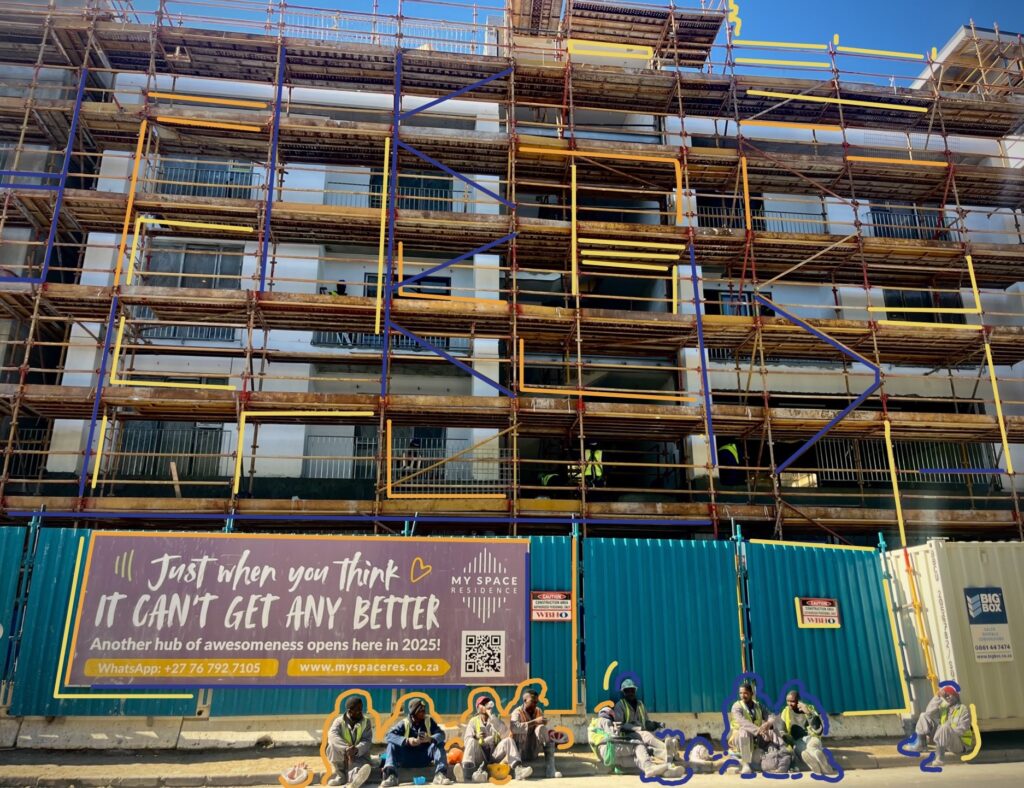
MySpace Dennesig is set to be completed by the end of 2025. GRAPHIC: Kiara Wales
Time and place
“There were always students,” says Annemarie. “We all had students [living with us], as did all of our neighbours; it was the culture.”
Pointing to a town map, Breedt explains that the plots now occupied by SU residences once belonged to “normal residential people”.
“Residences were built because there was constantly a shortage of accommodation on campus. It’s still the same,” says Breedt.
According to Morkel, maintaining harmony between students, long-time residents and their architectural styles cannot be overestimated. However, she describes this as requiring “sensitive, creative problem-solving [by all stakeholders] that is currently lacking”.
She stresses that Stellenbosch Municipality “needs to adopt a more proactive approach, rather than being reactive and finding loopholes”, in order to manage pressures from developers purely looking to make financial gain.
In Stellenbosch, changes to, or development on, a building that is 60 years or older require a specific application, which is reviewed by representatives from the municipality, Stellenbosch interest group and Heritage Western Cape, according to Morkel.
Municipal considerations regarding proposed land usage include its compatibility with, and impact on, the wellbeing of the surrounding community and heritage resources.
This is according to chapter five of the most recent official by-law on municipal land use planning, published by Stellenbosch Municipality in 2023.
The university itself is keenly aware of the sensitivities surrounding development in a town that many consider already densely built, especially with the high heritage value that many buildings hold due to their architectural significance. This is according to Martin Viljoen, SU spokesperson.
“Given that Stellenbosch University is not situated on a standalone campus, but is integrated into the fabric of the town, ongoing collaboration with the local authority is essential,” says Viljoen.
“This town won’t survive without students,” says Van Rensburg, discussing the centuries-old power struggle between the municipality, residents and the university.
Whose neighbourhood is it, anyway?
A tale of two cities, or rather properties, unfolds in Dennesig Street, Stellenbosch. One is a four-bedroom home costing Carel Albertyn, Joshua Generation Church pastor, R18 000 per month to house his family. The other, a luxury student housing complex offering bachelor flats for upwards of R14 500 per month.
Since moving to the neighbourhood of Dennesig eight years ago, the Albertyn family have witnessed the surrounding properties shift from homes with neighbours, to vacant lots occupied illegally, to a construction site, then, eventually, luxury student accommodation The One, Albertyn says.
A Google Earth search reveals that The One has been built in such a manner so as to wrap around the sides of the property on which Albertyn lives, occupying seven out of eight plots, a fact which he corroborates.
According to Albertyn, his landlord André Arman and other senior members of the church are among those who have stood against the “studentification” of the area. “[The developers] wanted us on their side,” he says. “They didn’t get my landlord.”
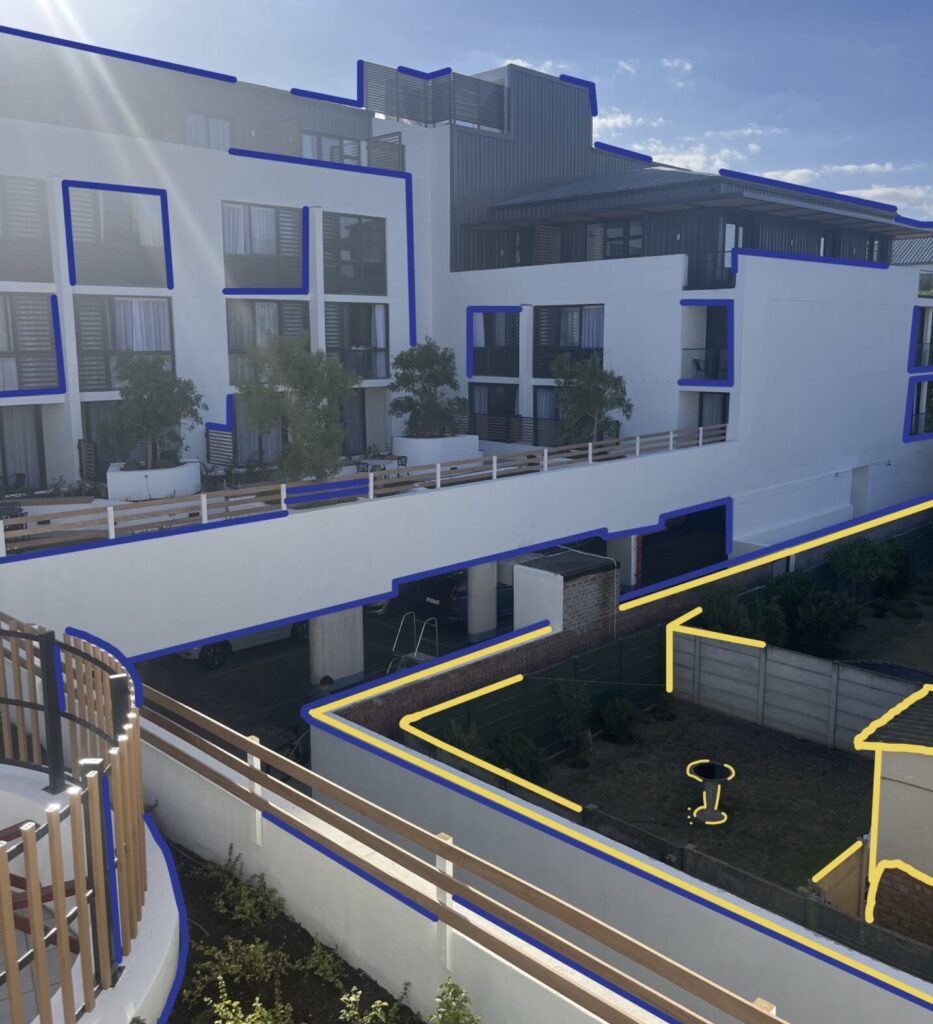
An aerial view demonstrating how The One wraps around the property belonging to long-time Stellenbosch resident André Arman. GRAPHIC: Kiara Wales
The 2023 municipal by-law states that the municipality “may approve an application subject to reasonable conditions that arise from the approval of the proposed utilisation of land”. These conditions include those relating to “agricultural or heritage resource conservation”.
Albertyn explains that part of the reasoning for his house’s affordability – compared with similar properties in “the middle of town” – lies in the fact that “you’d find few families willing to live there”, given the home’s proximity to the student development.
“It’s a principle thing – he could have been much better off […] They also offered him a lot of money, but he’s so principled,” Albertyn says of his landlord’s resistance to the developments around him. “The guy just wanted to stay at that stage […] He fought it till the end.”
Many previous residents were older people who were offered “disproportionate” amounts of money and thus found moving out to be an “attractive option”, given that many of the residential homes already housed students, Albertyn claims.
However, he says that his landlord and other long-time residents see the surge in student developments as “a massive disservice to what Stellenbosch is, and the history of Stellenbosch”.
Sharing anecdotes of their house being home to the local milkman a century ago, and how the skyline, now punctuated by multistorey flat blocks, used to hold a view of their neighbours’ avocado tree, Albertyn expresses that the neighbourhood has always been in a state of flux.
“To be honest, this area, gradually, long before these developments, has become increasingly student-dense,” he says. “[With] students coming in and out […], you aren’t super connected to the neighbourhood.”
The problems overhead
When architect Dennis Moss wrote up the town plans for Stellenbosch’s “historic core” in the 1990s, he stated that it should not have more than 75 000 people.
This is according to Morkel. As of 2025, World Population Review estimates its population to sit at approximately 123 000.
“Studentification” in particular is most common in towns where there is significant pressure for development and simultaneous growth of the university, which is not unique to Stellenbosch, she says.
Morkel provides examples of Leuven, Belgium and Makhanda, on a local level, as university towns in which the institution has a “prominent presence”, resulting in a contradictory situation where a shortage of student accommodation and the need for growth compete to define the town’s character.
However, she adds that the pressure on the university and the town as a whole is compounded by the sensitive nature of South Africa’s second-oldest town’s heritage.
Sunshine and rainbows
Judy Coetzee has lived in a jungle of construction and concrete – that is to say, Paul Kruger Street in Dennesig – for just over a year now.
“You feel like you’re living in a concrete jungle; the sun has been blocked off from this house because the buildings are so high,” she says. “It’s just not a peaceful place to live.”
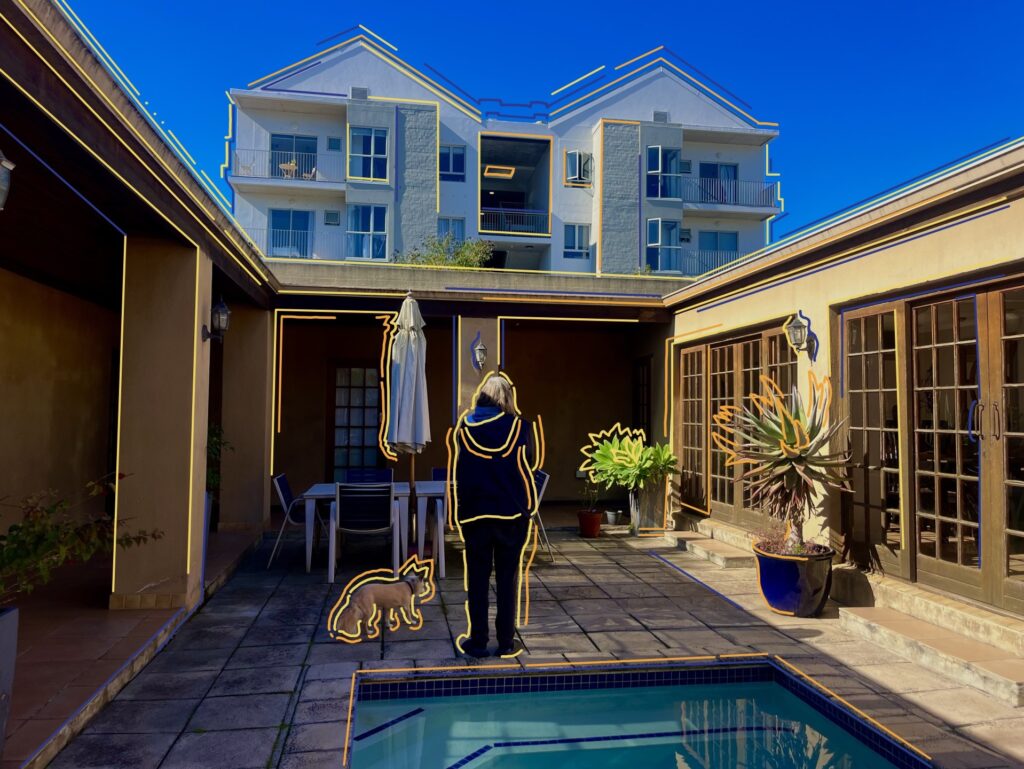
Judy Coetzee looks out onto the student development which partially blocks the entry of sunlight into the courtyard of her home. GRAPHIC: Kiara Wales
Coetzee, too, has watched the socio-economic changes effected in her neighbourhood since her move to help manage a guesthouse situated across from The One, during its construction in 2024.
“It was a really thriving guesthouse […], but with all this over the road, I mean, it’s killed it,” she claims. “I live here because I have to […], but I would never choose to, because you don’t see any horizons. You don’t see anything with all the students’ stuff going up.”
From their home, which looks out onto another luxury student housing complex completed in 2024, Pieter and Annemarie reflect on the infrastructural damage caused by studentification over the years.
“We had hell. There was almost a high court case,” Annemarie says.
According to the couple, damages range from gravel torn up by students’ sedans, pipes bursting after one too many impromptu car washes by an Uber driver to postboxes and potted plants stolen by students in the night.
“It was a period where they told us ‘at Stellenbosch, everything goes’ – you can sort of unsettle the neighbourhood, and that was the problem here,” Pieter says. “[Our] fence isn’t for skêlms [criminals]; it’s for students.”

Dr Pieter Maritz stands on the street that he has lived on for 50 years, observing the damage caused by the construction vehicles used to build the luxury student housing complex erected across the road from him and his wife Annemarie’s home in Simonswyk, Stellenbosch. GRAPHIC: Kiara Wales
Through the blocked-off sunshine and burst pipes comes a rainbow of sorts.
“What I want to stress is that we are not unhappy at the moment with the situation here or the students,” Pieter says.
Pieter recollects how students across the road from them forged peace with him as a “beneukde oom [grumpy old man]”.
“Sometimes when I work Saturday afternoons in the garden, they play Kaptein by Kurt Darren,” he laughs. “They start off their braai with one Afrikaans song to calm me down before [socialising] with their friends.”
Coetzee emphasises that the tumult surrounding a town’s construction and growth impacts all involved, saying that the noise, traffic and safety issues associated with developments disrupt the lives of the students in the area too. “It’s not only us,” she says. “It affects them too.”
Morkel reaffirms this, saying that she feels that students are often exploited accommodation-wise.
Developers offer students “the Stellenbosch experience” as a selling point, whilst “doing little to contribute to the heritage, the character of Stellenbosch”, she says.
A spirit runs through it
There is a term in urban design called genius loci, referring not to what one sees in a space, but how that space makes them feel. Simply, the architectural spirit of the physical place.
This is according to Morkel, who speaks of the ever-shifting terminology surrounding development itself moving from passivity to activity, which has allowed for change to be accepted as progress.
She believes that such thinking leaves little regard for the preservation of that which came before, evident in the didactic change in terms, from “heritage preservation” to “sustainable development”.
“Densification is not in itself a problem,” she says. “But I think where it’s impacting neighbourhoods in terms of scale that does not blend in […], it changes the character of the street.”
Pieter speaks of the slow transition of his neighbourhood to one steeped in youth more than tradition. “[The neighbourhood] has changed… the character of it.”
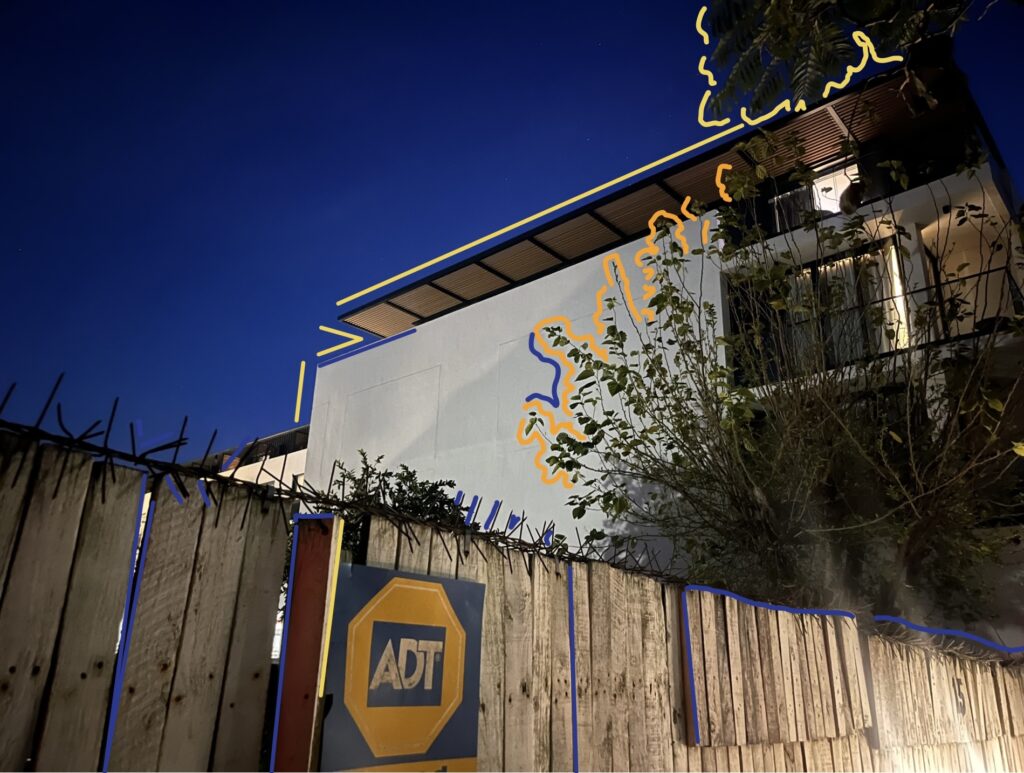
The silhouette of the boundary separating long-time resident André Arman’s home from luxury student development The One. GRAPHIC: Kiara Wales
In architectural terms, historical continuity refers to a story told through developing infrastructure, which must continue to flow in order to hold eligible value to visitors and residents alike, according to Morkel.
However, as Van Rensburg points out: “You can’t protect Stellenbosch as a museum. It’s a living, vibrant animal, and, inevitably, it’s going to bring about change.”
He emphasises the importance of the protection of the “core of heritage”, whilst accepting that time moves steadily forward. Just as there is a manner in which people can co-exist, so follows architectural regulations.
“On Helderberg Street, there is an old rectory and, at the back of it, some developer built this very contemporary concrete structure. [Yet] it is absolutely not in conflict,” says Van Rensburg.
“Accept that within the historic core, you’re going to get in-fill development, but hopefully it can be done in such a fashion that it is sensitive to architectural heritage.”
According to Viljoen, “all developments – including those by the university – must be aligned with the municipality’s future infrastructure planning”, emphasising the importance of collaboration between the various institutions shaping the town to ensure a sustainable future.
Morkel, too, sees a way towards co-existence, architectural and otherwise.
“Where a street has already got a particular nature […], we must pick up on those urban clues, so that the new architecture can be the heritage of the future,” she says.
An aerial view of the development of the Dennesig neighbourhood of Stellenbosch between January 2017 and December 2025. GIF: Kiara Wales
*Neither Stellenbosch Municipality nor The One residence had replied to requests for comment at the time of publication.