the men in the
mirror

‘Men are trash.’ A term often used when referring to masculinity in South Africa. The phrase’s lived reality has become synonymous with the state of manhood and masculinity in South Africa in the year 2025, a society where gender-based violence persists. It begs the question: What if manhood existed alongside activism?
I was 17 years old when we heard of her [murder]. It was the only thing everyone around the town was speaking about,” says Sibusiso Hadebe, referring to the murder of 22-year-old Karabo Mokoena back in 2017. “That was the first time I ever heard the phrase.”
‘Men are trash!’
For some, it’s a cry for justice in a nation clouded by gender-based violence (GBV). For others, it’s a mirror reflecting the alarming state of what it means to be a man in South Africa.
Hadebe grew up in Hillbrow, Johannesburg. Growing up in Twilight Children’s Home, he was constantly surrounded by male peers whom he refers to as brothers.
“I would always think to myself: Why would they say ‘all men’? We didn’t all kill her,” he says.
Mokoena was murdered in Johannesburg by her ex-boyfriend, who was later convicted for her death, Hadebe recalls. This added fuel to a movement that had begun in 2016.
“But that phrase bothered me. What did social media mean by ‘men are trash’? I am not trash,” Hadebe says.
#MenAreTrash first emerged on social media in South Africa in 2016 as a hashtag used by women to call out hateful, abusive or misogynistic behaviour they had witnessed or experienced.
“It is difficult to separate the gender from the problem when the overwhelming majority of perpetrators in South Africa are, statistically, men.”
This is according to Merlize Jogiat, operations and advocacy coordinator for Women For Change (WFC) – a non-profit organisation (NPO) combatting GBV and femicide in South Africa.
The phrase was a call for men to pay attention to the systemic issues of violence in the country and a provocation for dialogue, according to Jogiat.
Jogiat acknowledges that the statement “men are trash” doesn’t have relevance in the same ways that it did when it first came into use.
“It is unfair to group men in this way [in 2025],” she says. “However, it is difficult to separate the gender from the problem when the overwhelming majority of perpetrators in South Africa are, statistically, men.”
A report by the department of women, youth and persons with disabilities (DWYPD) found that about 3.4 million women have experienced physical and/or sexual violence by an intimate partner in 2022. According to the same report, 3.1 million men have physically or sexually victimised their partner during that period.
In 2019 and 2020, including the start of the Covid-19 pandemic and related lockdown regulations, 2 695 women were murdered in South Africa, according to the African Health Organisation. That is equivalent to a woman being murdered every three hours.
Defining masculinity
If men in South Africa sought for more than just one’s personal definition of masculinity, “conscious masculinity” would take precedence.
This is according to Dr Tania de Villiers, founder of Men with Conscience (MWC), a GBV intervention organisation which aims to foster a culture of accountability among men.
MWC was founded as a means to educate young men across universities in South Africa about accountability and activism, according to De Villiers, who is also the head of the division of nursing and midwifery at the University of Cape Town.
The ideal form of masculinity cannot be defined in universal terms, “but varies within and between different communities”. This is according to an academic article by Alinda M. Young and colleagues.
“I only knew how to be a man from my time [in Twilight Children’s Home], so it was not the best example. But I think [masculinity is] providing for those you care about as a man and showing up for them,” says Hadebe.
Conscious masculinity – moving beyond private declarations of respect towards public practices of justice – in public is never neutral; it is active, visible and disruptive of the status quo, according to De Villiers.
Dominant gender norms among South African males promote ideals of masculinity characterised by control, emotional stoicism and power, according to the article by Young and colleagues.
Hadebe, who now resides in Diepkloof in Soweto, started a wrestling squad of 14 young boys from the community, says that they watch wrestling every week, play football and sometimes attend sexual safety classes.
“I allow my boys to feel everything and be whatever they want to be as long as they [are happy],” says Hadebe.
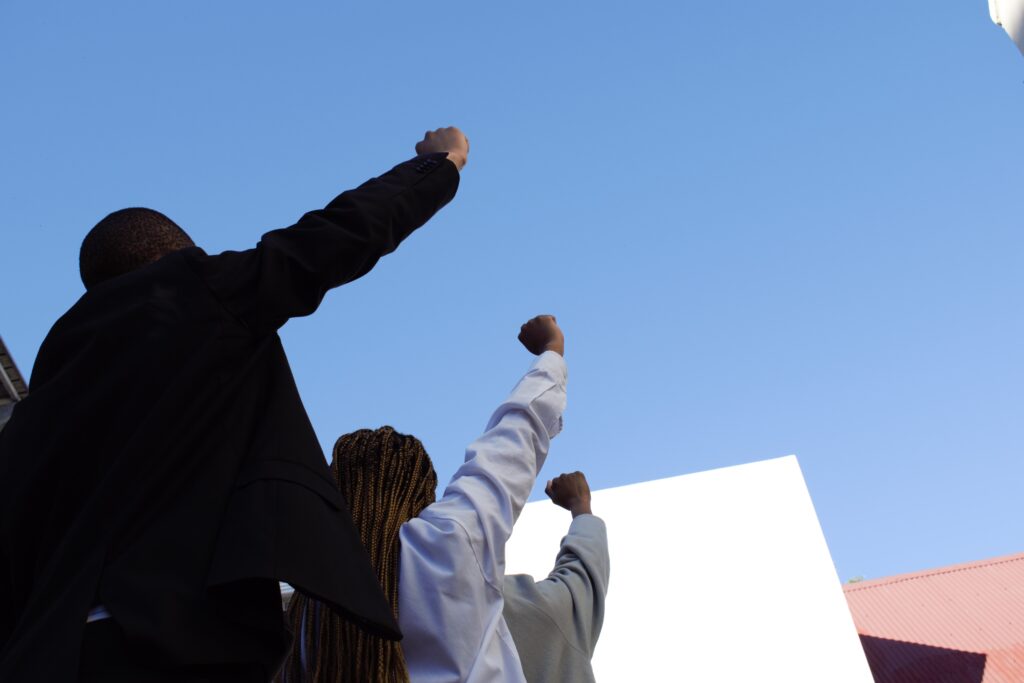
Redefining masculinity through allyship
Egos often prevent men from being allies against toxic masculinity, according to De Villiers, who explains that men cannot step into activism alongside women as “saviours”.
Jogiat acknowledges that those who are considered “allies” in the fight against GBV and femicide and those who promote positive masculinity, are often tasked with the responsibility of bearing integrity that is not measured by one man’s innocence but by men’s collective responsibility.
“I talk to the young boys [and] I challenge their ideas,” says Lwando Stemela, a participant in MWC in 2024. “When they say ‘like a girl’ as an insult, I stop them and ask: ‘Why?’ I tell them that the girls we play with on the street are just as strong, just as smart.”
“[Maculinity] was in the way the bhuti (older brothers) carried themselves, in the respect demanded by my uncles and in the quiet, heavy expectations from the elders,” he says regarding his experience growing up.
Father A Nation (FAN) is a non-profit company that addresses GBV, crime and fatherlessness by restoring and equipping men to be nation-builders, fathers and role models, according to Craig Wilkinson, FAN founder and CEO.
He says that, through teaching men to use their strength to love, serve, protect and provide and to be activists against any form of abuse, FAN redefines masculinity.

GRAPHIC: Ishmael Mabena
‘The “good man”… good for whom?’
Real goodness is seen in action that interrupts harmful cycles for the next generation of men, says De Villiers.
“It’s one thing to teach a man not to strike his wife and a completely different thing to take him back to the trauma that brought him there,” says Jogiat. “We are trying to solve problems without understanding the source and this has failed time and time again.”
Trauma in South African communities runs deep, according to Stemela.
“It’s the trauma of apartheid, of poverty, of fathers who were forced to be migrants and [thus] absent from their homes,” he says. “It’s a trauma of silence – men who drowned their pain in alcohol instead of speaking it.”
Men and boys do not talk about their emotions, says Wilkinson. “We hold our tensions and our struggles inside.”
“We hold our tensions and our struggles inside.”
He adds that every boy looks to his father and other older men to teach him how to be a man, yet fathers are often absent or have a poor understanding of masculinity themselves and other older men fail to model strong, healthy, positive masculinity.
Masculinity requires men to keep other men accountable, according to Jogiat.
“With my uncles and older men, I can’t be disrespectful,” Stemela explains. “It’s about connecting to their humanity first, before challenging a harmful view. It’s a slower process, but it works.”
Negotiating power plays
Society’s concept of masculinity alludes to sex, power and money, which Wilkinson describes as “macho messages”.
The existence of what De Villiers refers to as “male privilege”, supposes a power within masculinity and manhood, often placing men slightly above women.
Statistics South Africa’s (StatsSA) most recent report finds that in the second quarter of 2025, 65.6% of working-age men participated in the labour force, in comparison to 54.9% of women. That gap translates to millions of women who remain outside the labour force.
Meanwhile, the Broad-Based Black Economic Empowerment (B-BBEE) Chamber reports that women earn 23% to 35% less than men for the same work in 2025.
Therefore, the 23% and 35% represents South Africa’s stagnant median gender pay gap, according to B-BBEE.
Despite efforts to improve gender equity in the workplace – such as the Employment Equity Act of 2022 – the gap has narrowed only marginally over ten years, according to StatsSA.
According to De Villiers, reimagining masculinity means shifting from “power over women to power with women”. Thus, masculinity becomes a resource for healing and justice rather than a tool for harm.

GRAPHIC: Ishmael Mabena
“It’s moving from ‘chief’ to ‘comrade’. It’s understanding that my power comes through my connection to my mother, my sisters, my partner,” says Stemela. “Their success is my success. I cannot be free while the women in my life are afraid of me or limited by me.”
Men ought to leverage the influence they possess to open doors for others, redistribute authority and recognise the strength that lies within vulnerability, says De Villiers. “True power liberates: It creates a space where dignity and equality can thrive.”
The power of masculinity is not about controlling where a woman goes or what she wears, says Stemela.
“[MWC] made me see that a woman’s strength doesn’t diminish yours; it builds your home together,” he says. “It’s about standing with her against the world’s dangers, using your voice to amplify hers and creating a space where her dreams are as important as your own.”
The theatrics of masculinity
“We challenge tokenism by embedding long-term reflection, mentorship and evaluation into our programmes,” De Villiers says, regarding the work done by MWC. “Masculinity is a resource for healing the fractures of our society rather than deepening them.”
Masculinity cannot be performative when accountability takes precedence, says professor Louise du Toit, a philosophy lecturer at Stellenbosch University. “Lip service is too easy,” she says.
‘Men are trash’ is not an attack on men, but a reminder that, as she puts it, many men now see that the nation cannot be free until women, children, non-binary and queer people are free too.
“Until [men] start using their voices for good and not their fists, we might as well be trash,” says Hadebe. “How many more Karabos will there be?”