Society, shaped by the youth
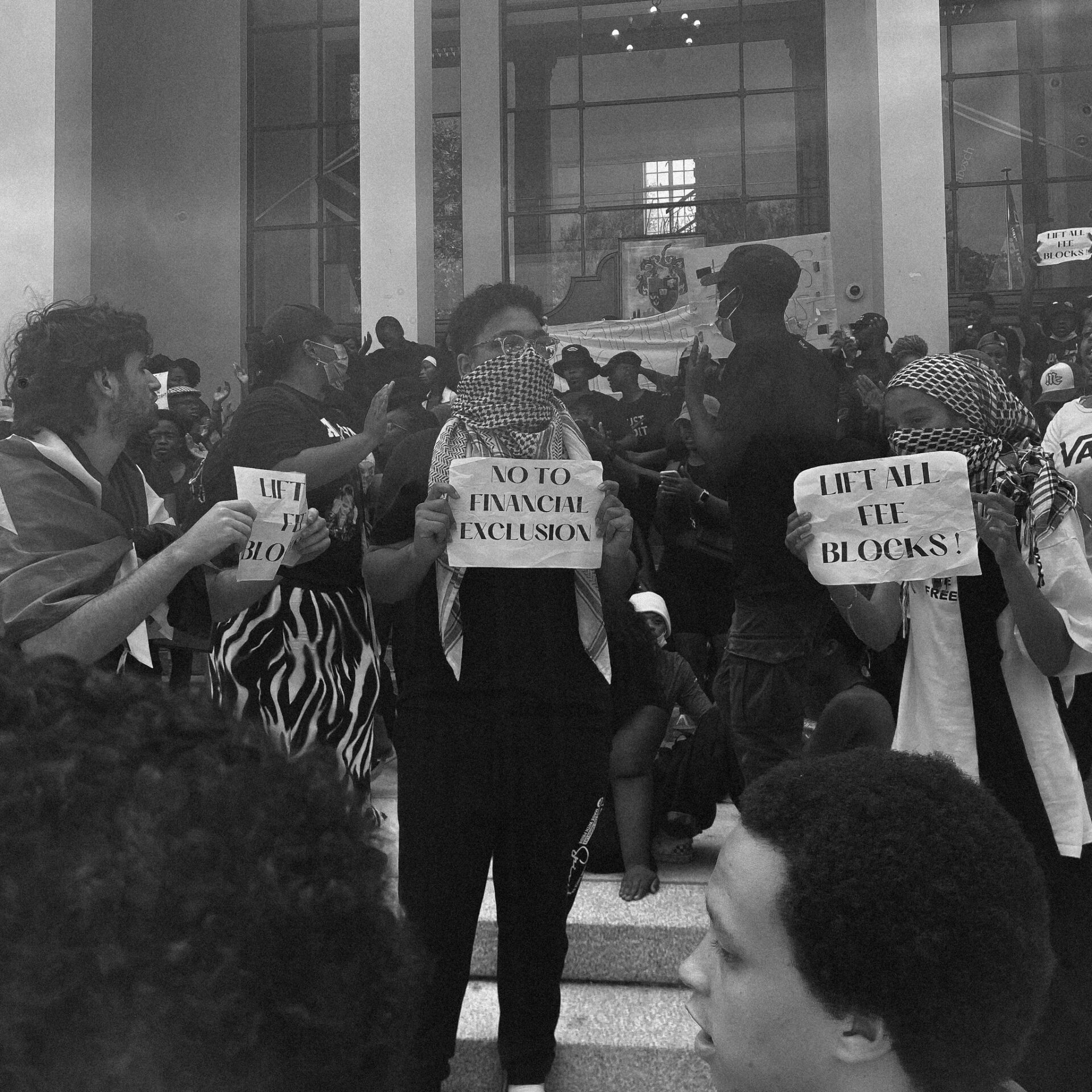
Student protesters outside Stellenbosch University’s Admin B building during the February 2025 National Student Financial Aid Scheme (NSFAS)-related protests. PHOTO: Enzokuhle Sabela
More than three decades after the start of democracy, many young people in South Africa are still fighting for inclusivity and access to food, education and employment. SMF explores how the youth are shaping their communities and country through initiatives, ranging from combatting student hunger to increasing civic and democratic engagement.
History of youth activism in South Africa:
1944 – ANC Youth League founded
1968 – South African Students’ Organization founded
1976 – Soweto Uprising
1994 – First democratic elections
2015 – #FeesMustFall movement
2019 -#JusticeForUyinene
2025 – National academic shutdown
Thaafir Mustapha was 18 years old when he shadowed a member of parliament. During this experience in 2023, he remembers thinking that parliament as an institution felt “tired”. “It felt like we could be doing better [in terms of democratic expression] and I still think so. I figured that a lot of that must be because of age; a lot of old faces in politics in the government,” he says.
This experience inspired Mustapha, now an LLB student at the University of Cape Town, to start SoWeVote, a youth voting advocacy group. He is not the only one to see the potential.
More than thirty years post 1994, young people in South Africa are still fighting for inclusivity and access to education and employment. In the past ten years, youth activism has presented itself in the form of the #FeesMustFall, #RhodesMustFall and Open Stellenbosch movements. This is according to Alysa-Abby Kekana, provincial convenor of the South African Students’ Congress.
Kekana believes that the youth of today should draw inspiration from the youth that came before them. “The youth of ’76 protested against the use of Afrikaans as a medium of instruction but provided an alternative. They did not just take to the streets and shut everything down, they proposed an alternative,” she says.
The role that young people have in South Africa has always been to drive a strong vision of what the country is capable of, says Mustapha.
Young South Africans have always tried to define their own image and what it means to be part of this demographic, says youth activist and policy writer Otsile Nkadimeng. For some people, being part of the youth means being politically engaged, dynamic and flexible. Gen Alpha, the generation born after Nelson Mandela’s time, will have their own definition, says Nkadimeng.
In South Africa, the term youth is a difficult one to define.
According to Statistics South Africa (Stats SA), the youth, defined as individuals aged 15 to 34, make up nearly a third of the country’s population.
For some, it reminds them of the Soweto Uprising. During apartheid, Afrikaans and English became compulsory languages of instruction in schools in 1974. On 16 June 1976, thousands of black learners embarked on a march against this policy, with many losing their lives after the march turned violent. This is according to an article published by South African History Online.
The word ‘youth’ has since been associated with political consciousness, struggle and celebration, with Youth Day being celebrated on the 16 June annually in commemoration.
“We have the power to shape discussions and decisions in a way that benefits us as young people.”
The history of youth activism in democratic South Africa
Since the advent of democracy in 1994, South Africa has embarked on a journey of cultural and democratic transformation. The transition to a democratic society marks a pivotal shift from a history rooted in racial segregation and authoritarian rule to one striving for equality, inclusivity and social justice, writes Bongiwe Khumalo, a researcher and educator based in KwaZulu-Natal.
The new democratic dispensation introduced a constitution that outlines basic human rights, promotes cultural diversity and emphasises participatory governance, in which Nkadimeng describes young people’s role in shaping society as a transitional one.
“Our role is to transition society from where it is [and] initiate contact actively of our own accord,” he says. “For some people, it happens at university or high school. We then have to effectively shape the world.”
According to Khumalo, young people occupy a central role in advancing cultural and democratic transformation in South Africa.
Youth are vital agents of change, embodying a hope for a more inclusive future, being uniquely positioned to challenge entrenched inequalities and stereotypes through leveraging their energy, creativity and digital connectivity to foster social cohesion and civic engagement, writes Khumalo.
“The older we get, [the more] we need to solidify our agenda to transition the world,” says Nkadimeng, regarding the transitional role of the youth.
“You’ve got to get more young people involved and get them to vote, because that’s the entry point.”
Civic engagement
“Finding a solution to the problem of democratic representation in South Africa was his priority and he wanted to educate young people before they became involved in the process,” says Mustapha.
“You’ve got to get more young people involved and get them to vote, because that’s the entry point.”
Meanwhile, a municipality on the Garden Route has also been addressing the lack of young voices in council matters.
In September 2013, the Mossel Bay Municipality adopted the Junior Town Council [JTC] programme, which aimed at giving the youth a mouthpiece regarding civil matters. This is where Ayabonga Hlumkeza, a youth social justice activist, gained the opportunity to get involved in civil, administrative and communal matters.
Hlumkeza, who was elected as the junior mayor in Mossel Bay JTC’s 2022/23 term at the age of 17, says that the programme is a youth development project, independent of politics.
“[The JTC project] brought together leaders from different high schools across the community that were going to have a voice in civic matters,” he says. “Its purpose was to represent the aspirations of young people and build leadership skills and encourage young people to be active in civic administrative and community life.”
According to Hlumkeza, he led multiple successful projects during his time as junior mayor, including fundraising, educational initiatives and an autism awareness project. The autism awareness program is still running, he says. “In my growth [during the initiative] I learnt how important it is to support neglected groups in our society.”
“Being part of the 2023 project was eye-opening. I learned that autism presents itself differently with [different] people on the spectrum,” says Hlumkeza.
The power of the youth
Kekana says that young people have a massive role to play in shaping society, despite the issues they face.
“As young people, we face ageism in various sectors and we are often undermined, but we have a unique role [to] mobilise everyone and provide key insights into discussions,” says Kekana. “We have the power to shape discussions and decisions in a way that benefits us as young people.”
Ndlovu holds the same sentiment, believing that young people are the key to bringing new ideas to outdated systems.
“We bring fresh ideas and the courage to question old systems and refine them to fit the time we live in today,” she says.
Referencing the youth of 1976, Mustapha says all generations of young people since 1976 have played a similar role in bringing change. “The youth are a strong majority that drives the change and vision of what the country can be,” Mustapha says, regarding the role of young people in shaping society. “We saw this during the Soweto Uprising about 50 years ago: They stood up against apartheid and the world listened.”
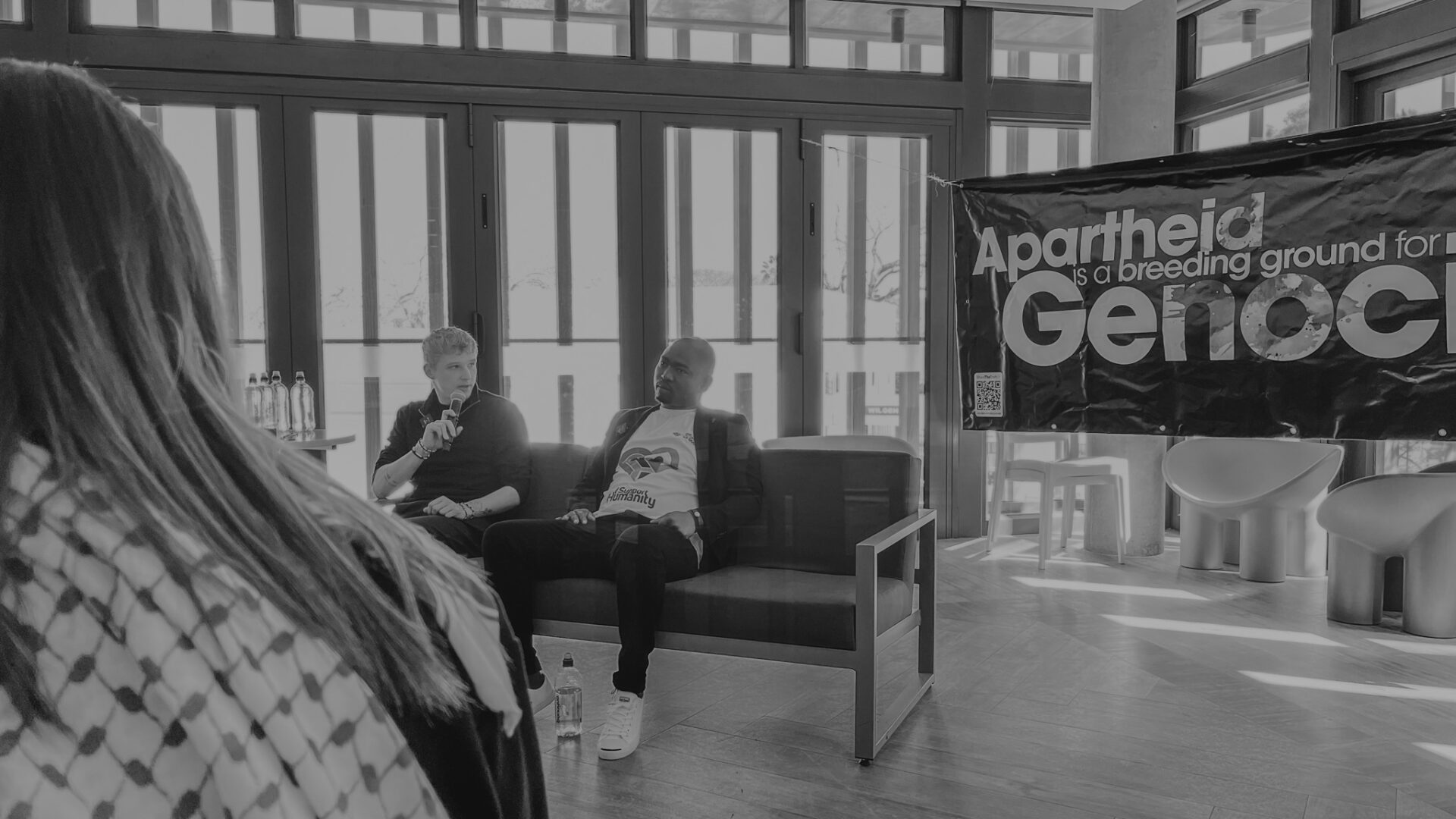
South African human rights activists and political commentators Pieter Kriel (left) and Nkosi Zulu (right), from the Coalition for Good, share their findings from their expedition to Palestine at a discussion hosted by the Student Action for Palestine. PHOTO: Enzokuhle Sabela
“We have the power to shape discussions and decisions in a way that benefits us as young people.“
Practicality in a time of online activism
While many young people might be active on social media and use its various platforms as a means of activism, nothing replaces practical involvement, says Nkadimeng.
“People are on the user-end of social media. They are not interacting from a position of having been there [on the ground],” he says.
Although social media is a powerful tool that can be used to amplify activists’ voices, “there’s only so much that hashtags can do”, Ndlovu says. “[Activism] needs to be followed through by hands-on engagement.”
According to Ndlovu, a lot of young people are active behind their phones, but when it comes to actually being on the ground and working things out, it’s a bit tougher.
“Although social media is a tool, like AI, it’s not going to solve the problem. It can help you get to the solution,” says Mustapha.
“It’s about choosing to make a positive impact in someone’s life.”
Youth living actively
Striving to live an active public life through keeping in touch with her community, Kekana told SMF that she ran in Stellenbosch Municipality’s by-elections in May 2025, at 24 years old.
“I’m very big on grassroots activism and ensuring that you don’t become detached from your community,” she says. She claims to be the youngest candidate in the country to run for an election of that nature.
“I was first introduced to youth activism in my first year at Stellenbosch University in 2019, taking part in various protests and campaigns over the years,” Kekana says.
Showing up for your community is the simplest way to live an active public life, according to Ndlovu. “It’s about choosing to make a positive impact in someone’s life,” she says.
Mustapha believes living actively and consciously is intrinsically linked to being a good person. “The way I think about it… politics is so personal. You’re doing something political even [by] being a good person,” he says.
According to Hlumkeza, “being present, engaged and contributing meaningfully to the progress of a community is living an active public life”.
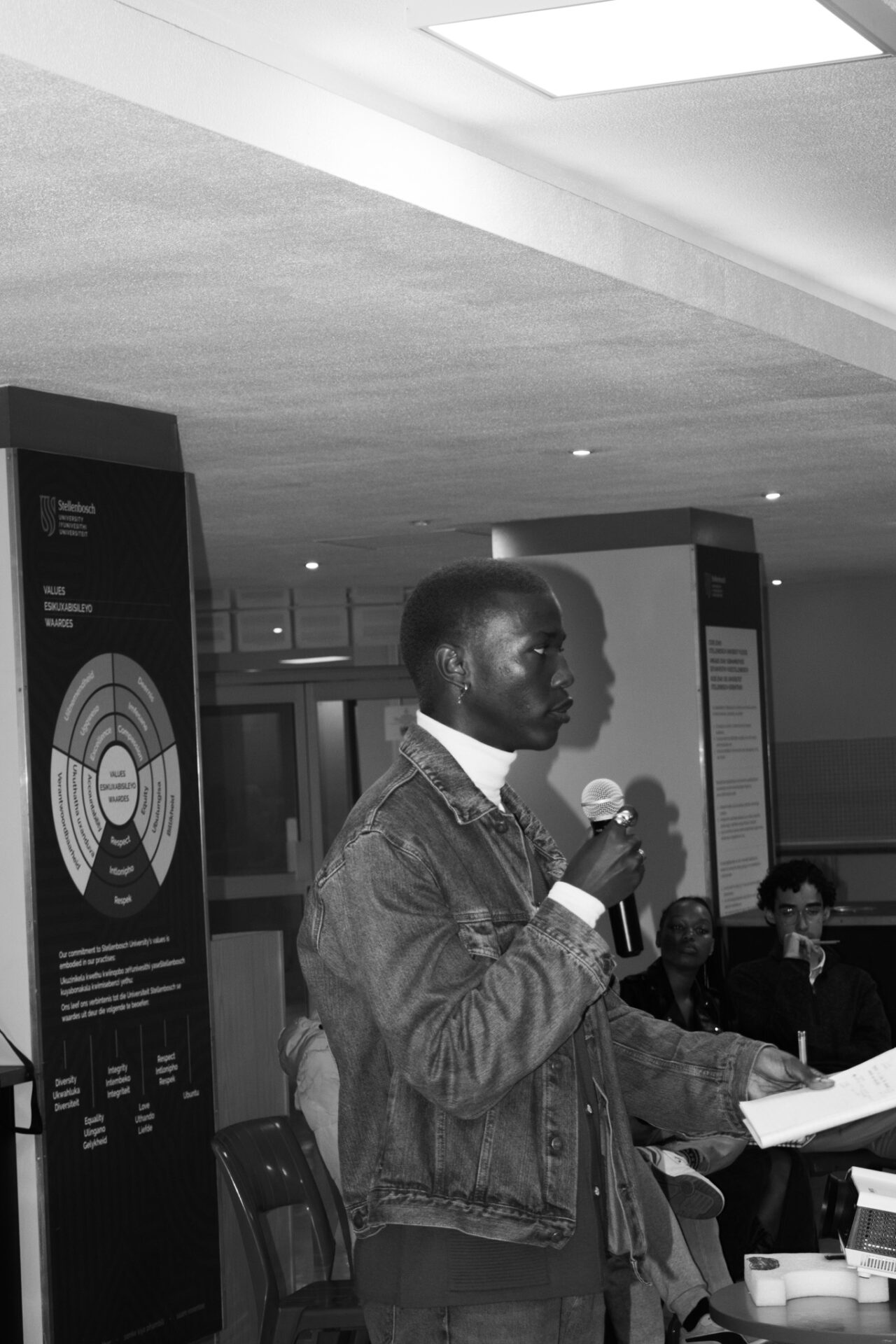
Student Representative Council (SRC) candidate Culumanco Mangqo sharing his election manifesto during SRC elections at the third caucus hosted by the Student Electoral Commission. PHOTO: Enzokuhle Sabela
Combatting food insecurity
“ShareBite is a community-driven, student-led organisation that deals with combatting hunger on campus.”
This is according to Nothando Ndlovu, a student at Stellenbosch University (SU) and operations manager of ShareBite.
The 23 year old, who also serves as the chairperson of Russel Botman House, a senior SU residence, says that the non-profit organisation is looking at expanding across all campuses in the country and targeting surplus food from farmers, companies and different organisations with the intention of giving back to the community.
According to Ndlovu, the organisation was founded by Francisca Darkoh, a master’s student in psysiological sciences and a Mandela Rhodes scholar at SU. Originally starting out as a soup kitchen in 2024 under the name FOODBYFRANIDEE, it was rebranded to ShareBite in July 2025, primarily targeting SU students, she says.
“[During] A3 assessment season, the supplementary assessment period at SU [last year], a lot of students were asking if there was food at residences,” says Ndlovu. “We thought: ‘Let’s make a meal, prepare and call students to come and get food.’ Then it became bigger, and we kept going until now.”
ShareBite feeds approximately 250 students every time they host soup kitchens, which occur on public holidays, according to Ndlovu. She says that the organisation’s goal is to tackle gaps that bigger entities tend to overlook.
“Our initiative is crucial; we tackle the gaps and the cracks [funding, accommodation and food] that the big entities overlook. Ndlovu believes that a lot of non-profit organisations will target communities but overlook gaps, such as students.”
ShareBite exists to help students who are overlooked, such as those forming part of the “missing middle”, says Ndlovu.
The missing middle refers to students whose families earn too much to qualify for government-funded financial aid through the National Student Financial Aid Scheme (NSFAS), but too little to afford the high costs of tertiary education without financial strain, writes Melissa-Seané Sathekge, student and part-time writer for the online publication bursariesportal.co.za.
“Everyone will think students have bursaries and everything they need, not knowing the problem is deeper than that. There are missing middle-class students who are overlooked and that is where we come in,” she says.
A lot of students do not necessarily communicate their need for food, says Ndlovu. Thus, ShareBite is working towards allowing these students the dignity of access to food that they did not have to ask for.