
a ‘vulnerable’ symbol
Across South Africa, conservationists, farmers and researchers are fighting to protect a fading symbol: The blue crane – newly classified as “vulnerable” by Dr Christie Craig, conservation scientist at the Endangered Wildlife Trust and the International Crane Foundation. Their work unfolds in farmlands and wetlands, a depiction of the delicate balance between agriculture and conservation.
Daniélle Schaafsma
The road winds endlessly through the farmlands, dust rising behind the car as the search stretches into hours. Every fynbos shrub, every patch of veld, is scrutinised, the eyes playing tricks with herons and wandering guinea fowl that, for a moment, mimic the silhouette of South Africa’s national bird.
The blue crane is said to be common in these parts – the Southern Overberg – yet they seem impossibly elusive, as if its vulnerability has already begun to erase it from the landscape.
Then, in the middle of an open field, two blue cranes finally come into view. They move slowly through the grass, long legs carrying their light-grey bodies with an easy grace. From their wings hangs a distinctive plume of trailing feathers, shifting as they step.
From a distance, they blend almost seamlessly into the pale landscape, so easy to miss, despite their size. Watching them, it becomes clear how easily they could be overlooked – two quiet figures in a wide, pale landscape.
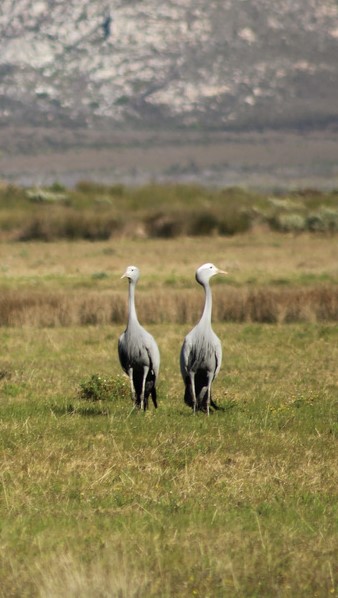
Two blue cranes in Agulhas National Park. PHOTO: Daniélle Schaafsma
‘Vulnerable’
After World War Two, there was a shortage of food, and people realised that areas in the Overberg were good for grain farming, according to Mick D’alton, co-founder of the Overberg Crane Group (OCG) and member of the Nuwejaars Wetlands Special Management Area (SMA).
Following this, grain farming was promoted and as a result landowners started removing fynbos as part of their agricultural expansion, he says. The land became suitable for cranes, providing abundant food and nest sites for the species.
The population estimate for blue cranes in South Africa is currently 51 000, according to Dr Christie Craig, conservation scientist at both the Endangered Wildlife Trust (EWT) and the International Crane Foundation, in a recent academic paper. Although this might seem like a substantial amount of cranes to the average person, these numbers are concerning.
Between 2011 and 2025, there has been a 44% decline in blue cranes in South Africa, says Craig.
Recently, Craig’s research led to South Africa’s national bird, the blue crane, being reclassified and up-listed to “Vulnerable” in the regional Red Data Book of Birds of South Africa, Lesotho and Eswatini.
Both the South African and International Red Data books are updated in intervals of five to ten years, and while the global list was updated in 2021 already, the updates to the South African list this year were informed by Craig’s research, she says.
The blue crane was classified as “Near Threatened” on the regional list in 2015, based on data which indicated a generally steady population at the time, according to the South African Red Data book. However, this is no longer the case, with a recent analysis showing a population decline.
On the red list, there are three threatened categories: critically endangered, endangered and vulnerable, according to Craig. She says the status of the blue crane was assessed by tracking population trends and numbers over three generations. The research shows that blue cranes’ numbers “have declined and are predicted to decline by more than 30%”, over those three generations, which on average amounts to 37 years says Craig.
The national bird
The cranes in the field pause, lifting their heads in unison at the sudden flap of a guinea fowl taking off nearby. For a moment, they stand still, necks stretched tall.
“It’s our national bird – people should be caring about it,” says Annie de Villiers, an MA (History) student at Stellenbosch University. “You can’t separate its status as a national symbol from anything. It is intrinsically entangled.”
Rock art, storytelling and folklore:
- In San art, blue cranes are depicted as social creatures, always with a person. In folklore, it is believed that blue cranes were human once. For the San, the blue crane was a feminine, protective, mentor animal that symbolised transformation and transition, from life to death.
- For early Nguni groups, the blue crane was a masculine bird that represented a warrior and protector. This can be seen when looking at the famous Zulu king, Shaka Zulu, who donned a blue crane feather in his crown. In this culture, blue crane feathers are seen as a status symbol.
Interest in the beauty of the blue crane:
- Colonial explorers heavily documented sightings of blue cranes, hunting of the bird and how they were caught to be kept as pets.
- An image from 1890 shows a woman at De Hoop in the Western Cape, who owned two blue cranes.
- In the early 1900s, the South African national zoo shipped a blue crane to the London zoo. The crane was named Joey and attracted a lot of tourists’ attention to South Africa.
Becoming the national bird:
1961 - South Africa became a republic:
- During this time, there was quite a big push for new national symbols. After long deliberation, the blue crane was chosen as the national bird in the same year. The final factor that influenced this was the beauty of the blue crane’s silhouette, as it would look good on a coin.
1965 - The five-cent bird:
- The first five-cent coins with blue cranes were printed.
1994 - Negotiations for democracy in South Africa:
- There were a lot of discussions around apartheid symbolism, and with this came the creation of a new flag, a new national anthem and a new coat of arms. The blue crane remained the national bird but was not featured on any national iconography. The secretarybird took its place as it was argued to be a stronger symbol of strength.
Information from Annie de Villiers, an MA (History) student at Stellenbosch University, who is researching the history of the blue crane as a symbol in South Africa. INFOGRAPHIC: Daniélle Schaafsma
Today, however, the blue crane doesn’t feature on any national iconography, says De Villiers.
The blue crane has featured on the five-cent coin since 1965, she says. But it was removed from circulation in 2012, according to a media statement by the South African government.
‘Custodians of cranes’
While the bird is a source of pride in South African culture, it has historically been at odds with agricultural practices, particularly in regions where its presence was perceived as disruptive, says De Villiers.
Around 99% of cranes occur on private land, according to Bradley Gibbons, senior field officer at the African Crane Conservation Programme of the EWT and the International Crane Foundation.
“Farmers are really important; they’re basically the custodians of cranes, especially in the Western Cape,” says Craig. “It’s always sort of a balancing act of agricultural productivity and conservation.”

Mick D'alton, a farm owner just outside Bredasdorp. D'alton is the co-founder of the Overberg Crane Group and a member of the Nuwejaars Wetlands Special Management Area (SMA). PHOTO: Daniélle Schaafsma
Cooperation with landowners to mitigate the threats against blue cranes cannot be forced; it must be cultivated, says Gibbons. As a field officer, he is tasked with raising awareness surrounding threats to blue cranes and other birds.
When farmers see 300 cranes in a flock, they often ask: ‘How can they be vulnerable?’, Gibbons says. But those numbers don’t tell the whole story. In reality they are seeing low chick survival rates and high mortality from power-line collisions, he says. One sweep of a disease like bird flu would put them at great risk, he adds.
The power-line problem
Power-line collisions claim large numbers of cranes each year, according to D’alton.
“Blue cranes actually crash into power-lines,” says Gibbons. “They just can’t see them when they’re flying.”
But they have found a solution to this threat, he says. To make power-lines more visible, they add “flappers” or “bird-flight-diverters” to them. These diverters are installed by Eskom, he says.
“That’s very good for us, obviously, for the fact that we have this relationship with Eskom is what makes life a lot easier,” he says. “They came to help us, we came to help them. It’s a win-win situation.”
Research has found that bird-flight-diverters are “quite effective” in reducing power line collisions, according to Craig.
Reporting the problem:
If a person comes across a dead blue crane, it is advised that they should report it to the Endangered Wildlife Trust (EWT) helpline, and a field officer will be sent out. This is according to Bradley Gibbons, senior field officer at both the African Crane Conservation Programme of the Endangered Wildlife Trust and International Crane Foundation. The field officer reports the incident to Eskom, who then sends someone to install flappers and covers the cost of the process, he says.
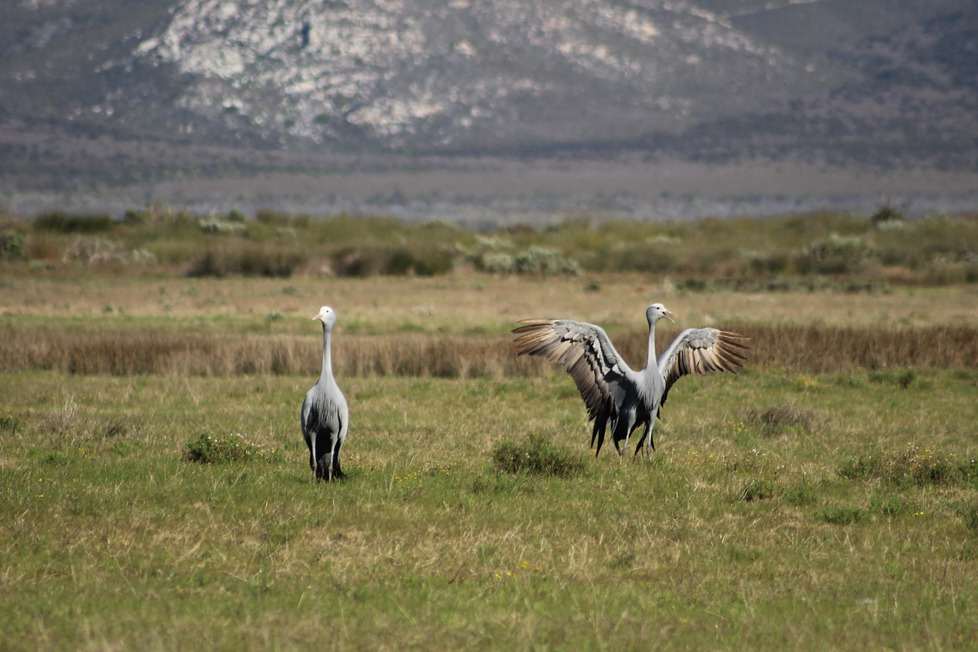

Blue cranes in Agulhas National Park. PHOTOS: Daniélle Schaafsma
‘Doing a favour’
According to Gibbons, a large part of the EWT’s awareness campaigns are aimed at bringing attention to the fact that blue crane conservation consists of many small changes and adjustments that landowners can make to try to help.
Blue cranes are omnivorous, and “they’re actually doing a favour for farmers in many cases by eating all the worms and the things like locusts”, he says.
D’alton, however, says that even though landowners are always interested in knowing how their conservation efforts can benefit them, “that’s not what it’s about”. Having land is not only about making a profit, but caring for everything on the land too, he says.
Besides poison control and monitoring where flappers are needed, landowners can also help blue cranes by reducing disturbances at nest sites, Craig says.
“What can [also] sometimes happen is chicks, when they’re quite small, try to go and drink out of a water trough and then drown because they can’t get out,” says Craig. “Farmers can place rocks in the trough, which allows them to get out safely.”
‘Nature’s tax’
Gibbons admits that blue cranes can cause damages on a farm. In some cases, when large flocks gather before the first rains, trampling damage can occur, he says. However, blue cranes do not cause any damage by eating the seedlings, according to Gibbons.
Then there is also a chance of blue cranes helping themselves to feed that farmers have put out for their sheep, says Gibbons. While this influences farmers’ attitudes towards blue cranes, Gibbons refers to it as “nature’s tax”.
“They were there before us, and I know I need food as well, but just give them a little bit,” says Gibbons. “We have to give them some kind of respect.”
Farmers can keep blue cranes out of their feeding troughs by putting a wire around the trough, high enough so as not to be in the farm animals’ way but to stop cranes from sticking their heads and eating the grain, according to D’alton.
Gibbons described the intricacies of crane conservation as being a collaboration between blue cranes, farmers and the EWT and similar organisations.
Rehabilitating an ecosystem
A sudden, sharp call rings out, rising above the stillness of the veld. It cuts clear through the air, a sound at once haunting and delicate. The second bird answers, its cry lower, the two voices overlapping. When the sound fades, the silence that follows seems even deeper, as if the landscape has paused to listen. It is within this fragile balance of movement, sound and stillness, that new efforts have emerged to carve out safe spaces where the species can endure.
The Nuwejaars Wetland SMA on the Agulhas Plain in the Overberg region has brought together 25 landowners since its initial planning stages in 2002 and establishment in 2008. The landowners each chose to separate a part of their land, about 45 000 hectares in all, for conservation efforts. These efforts involve actively not farming on those pieces of land, says D’alton.
“Instead of fencing in some more areas, we want to fence in agriculture and let nature – the rest of the natural area – be one,” says D’alton.
They have successfully reintroduced hippos, along with buffalo and threatened bird species, and have made the area safe for animals to roam, says Heather D’alton, head of communication for Nuwejaars Wetlands SMA and co-owner of LoveGreen Communications.
“Things can recover if you give them a chance,” she says.
The blue crane’s vulnerability as a species not only influences a farm’s physical ecosystems, but as the national bird, it also has a significant influence on South Africa as an ecosystem of its own, says Gibbons.
“It would be quite embarrassing if the numbers go [too] low,” says Gibbons.
Preserving the blue crane requires not only protecting its habitats and addressing immediate threats, but also fostering awareness and appreciation among communities across South Africa, according to Gibbons.
For De Villiers, the challenge is both cultural and ecological.
“Conservation succeeds when you can convince the people who dislike the bird to see its value,” she says.
Back in the field, the cranes move with unhurried grace, their pale forms almost dissolving into the grass. One lifts its head and calls, the sound carrying clear and long over the quiet land. A shadow passes overhead – another crane glides low, wings outstretched, its silhouette cutting briefly against the sky before disappearing beyond the horizon.
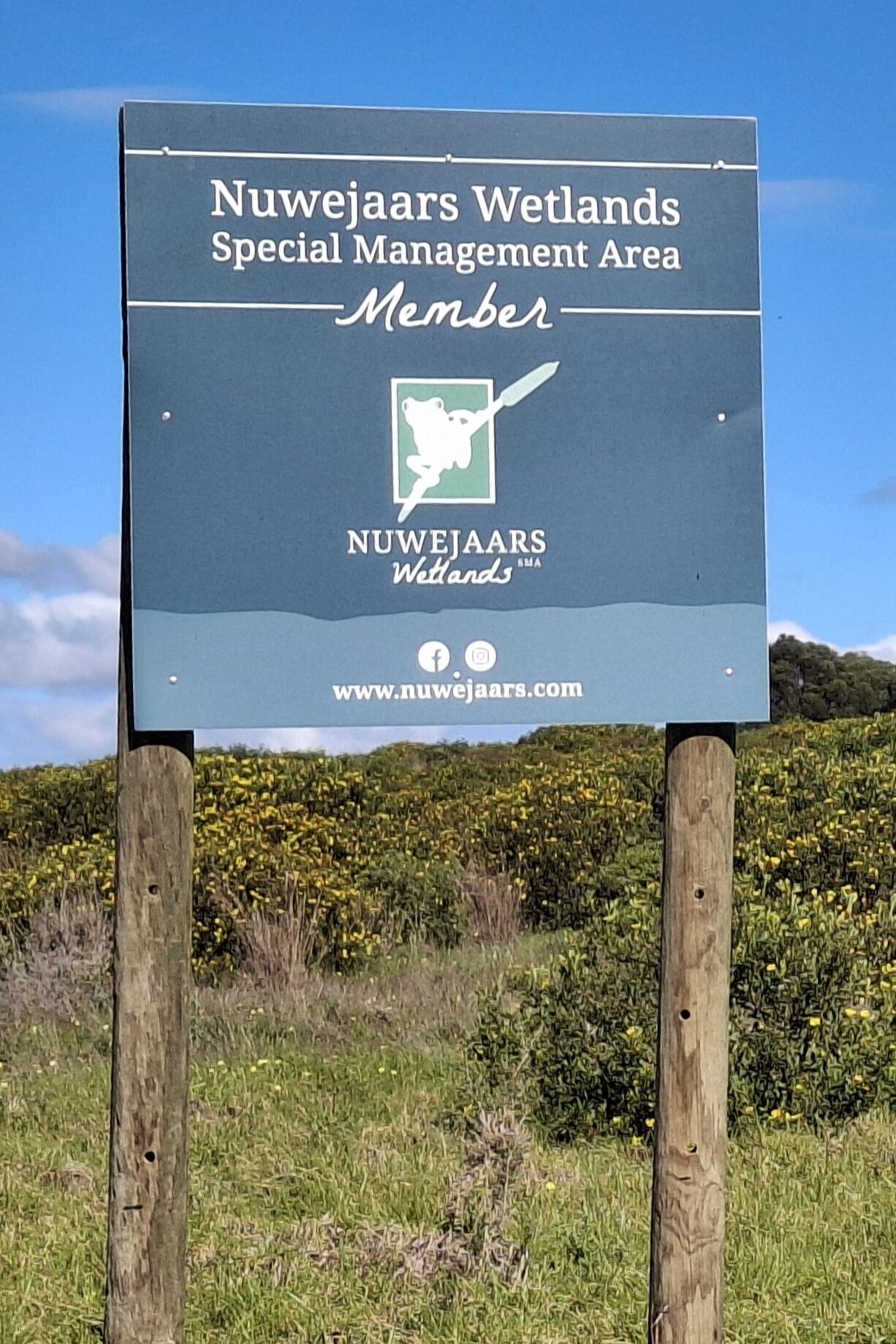
The Nuwejaars Wetlands Special Management Area (SMA) has brought together landowners who chose to separate a part of their land for conservation and actively don’t farm on those pieces of land, according to Mick D’alton, co-founder of the Overberg Crane Group and member of the Nuwejaars Wetlands SMA. PHOTO: Daniélle Schaafsma