Story–
TellinG:
Linking South Africa’s past, present and future
Throughout South Africa, the future of storytelling is being determined through teachings of heritage, history and resilience. Stories that were once told around the fire at sunset are now relayed in classrooms. This is according to Dr Gcina Mhlophe, a renowned author and storyteller.
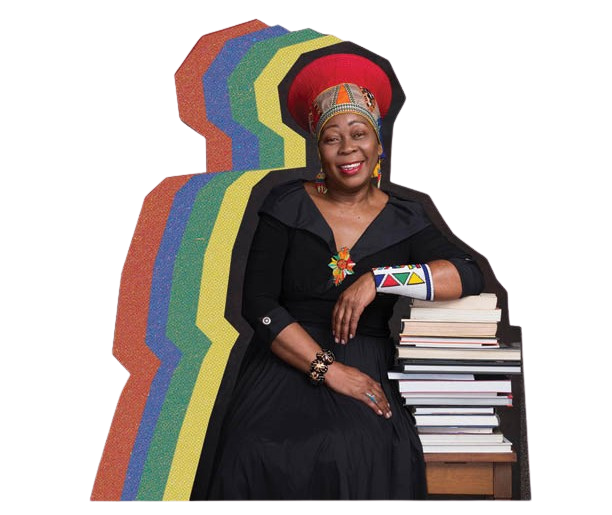
Dr Gcina Mhlophe, a celebrated author, storyteller and founding director of Gcinamasiko Arts and Heritage Trust, promotes activism through her foundation. VISUAL: Lienke Norval & Anke Spies
In the heart of South Africa, the literary landscape narrates stories of real people in both the past and present. It is not only about telling tales, it is about narrating real stories that reflect history, love, struggle and the fostering of hope, says Dr Gcina Mhlophe.
Mhlophe says she promotes activism by helping teachers to find new ways to engage with students through literature and storytelling.
“[Teachers] don’t know how to do it, so to try and empower them, that is activism. For me, the struggle has never been over,” says Mhlophe. “So many people don’t know about [South African history], many don’t even know about their own family history.”
In 2012, she founded the Gcinamasiko Arts and Heritage Trust, a non-profit organisation (NPO) aimed at promoting art literacy by equipping teachers to engage with students through creative arts, literature and storytelling.
The trust has adopted a storytelling tree on the South Durban basin at the Bluff Showgrounds, which attracts “people from all over”, according to Mhlophe.
“They want to see the storytelling tree […], we perform under the tree. The symbolism of that is that the tree used to be the place where villagers held important meetings.”
In the past, stories were told under trees, lovers would steal their first first kiss under trees and some of the first schools were held under trees, she says.
Mhlophe says nobody understood what she was doing when she asked for permission to use the big tree at the Bluff Showgrounds.
“I was saying, ‘Let’s go back to the source. If we cannot have the central fireplace in the house, let’s have a tree that becomes our public central fireplace’,” she says.
For Mhlophe, storytelling is a calling, one deeply rooted in her heritage.
“I tell stories to wake up stories in other people, because I believe that every living being has a story to tell,” she says.
In the modern era, where many families are disconnected, the oral traditions of grandparents telling stories are no longer a reality, says Mhlophe.
“For me, storytelling picked up from the oral tradition to the school setting, formal schooling, where I could read and write,” she says. “But, also, it took me right back full circle into the oral tradition.”
Mhlophe cherishes oral tradition because it is passed down from older generations to children and young people in academic institutions.
“I like […] the versatility of storytelling,” she says.
A history of resilience

GRAPHIC: Anke Spies
South Africa’s writing, in its infinite variety, is a testimony to the ability of art to live on after the catastrophe of apartheid, according to Dr Wamuwi Mbao, a senior lecturer in English Studies at Stellenbosch University.
Writers were a crucial part of raising cultural awareness about South Africans’ lived experiences, says Mbao.
“The political facts of what was going on under apartheid were well-known, but literature gave those facts a human face. Literature allows sympathetic identification – in other words, it allows the reader to imagine themselves in the shoes of someone different from themselves,” he explains.
Freddy Letsoalo, a student writer and voice instructor at the University of the Witwatersrand, Johannesburg, says that South Africa’s resistance literature carried a heavy political weight.
Some literary works were banned by the apartheid state, including books by Robert Sobukwe and Solomon Mahlangu, but some books managed to grab international attention, where they helped shape global perceptions of apartheid, says Letsoalo.
He believes that writers today can still expose truths in ways to shift collective awareness. “We cannot change the whole world in a day, but if we write about it, if we speak about it, then more people will see it.”
Mbao says that art should never be underestimated as an instrument of social change.
“History teaches us that we need writers and other artists to humanise our struggles,” says Mbao.
Literature shapes life
Mbao found that growing up with a passion for reading led to standout performances in English. “It seemed like a natural progression to study literature after [high] school,” he says.
As a lecturer, Mbao’s passion lies in exploring how reading shapes our understanding of the world. Through teaching literature and close reading, he delves into the transformative power of reading.
South Africa, he explains, is soaked in narrative, with many stories existing regarding how people have come to live together, what cohabitation has cost and what was gained or lost during these processes.
“Many of these stories are deeply painful, because they deal with our long history of violence and dispossession, but they are equally stories of resistance, of survival, of learning to live on after the many terrible things that have happened to families, communities and individuals,” he says.
Mbao reflects on why stories reach people more deeply than facts. “Narrative guides us and instructs us in making sense of the world, and this is ever more necessary in a world of more and more information masquerading as fact,” he says.
“We can use narrative as a compass to negotiate our way through the information that crowds our attempts to find meaning,” says Mbao.
Masindi Netshakhuma, who is on the board of directors at the Tshivenda National Lexicography Unit, describes literature as a map of her life. She grew up with lots of stories, some spoken, some written down, all carrying the weight of what her people went through, she says.
“[Stories] revealed to me the richness of our heritage and gave me the language to express my own journey, as well as the courage to preserve voices that might otherwise have been silenced,” says Netshakhuma, adding her belief that storytelling and literature build confidence and foster a deeper connection to learning.
Similarly, literature has changed and shaped how Letsoalo sees the world. From reading different types of literature, he has developed greater knowledge of both his craft and his personal life, he says.
Letsoalo says that the more he consumed literature, the more he was able to write and speak more confidently.
“Readers are writers,” he adds.
Letsoalo further explains why stories often carry more weight than plain facts. “Stories reach people more deeply than facts because in most cases you find that facts are not relatable, but if we turn the facts into stories that the people can relate to, then it […] simplifies the transition or transmission of the knowledge.”
Storytelling allows the storyteller to split facts in a creative way, which makes people listen and engage because they feel part of the story, according to Letsoalo.
“I tell stories to wake up stories in other people, because I believe every living being has a story to tell.”
Education for generations
Educators remain at the centre of storytelling, says Netshakhuma. She believes that they are the custodians of culture, carrying an important responsibility to teach prescribed content and to transmit the stories that shape South Africa’s identity to the youth.
“By integrating storytelling into the classroom, educators ensure that our heritage is not lost but continues to evolve with each generation,” she explains. “They give learners the opportunity to see themselves as part of South Africa’s ongoing story.”
According to Letsoalo, literature can provide tools for coping with challenges and adversity. He says that it can help build confidence and self-esteem, empowering individuals to overcome obstacles.
Growing up, Blessing Shongwe, a playwright, director and a master’s student in communications at the University of Limpopo, listened to stories at home, at school and in his community, and, through storytelling, he learned values such as resilience and respect for people, he says.
According to Shongwe, storytelling has strengthened his confidence over time. “[Storytelling] just grew beyond entertainment. It became a tool […] that shaped my creativity and strengthened [it].”
Storytelling is an age-old way of documenting events, sharing thoughts and recollections and expressing feelings, says Caryn Dolley, a journalist at Daily Maverick.
Creative writing can present critical information in easily absorbable ways, says Dolley. She adds that it is a critical way to present information in a more accessible and memorable manner in education.
“Complex ideas can be conveyed via a colourful story, [and] a dry topic can be written in a way that transforms it into a captivating subject,” she says.
Penning the future
Netshakhuma describes literature and storytelling as diverse and transformative.
“I believe South African storytelling will continue to amplify our voices, strengthen our communities and inspire new generations to draw strength from our rich and beautiful past,” says Netshakhuma.
Mbao believes that today’s writers must continue addressing society’s deepest fault lines. “South African writers have always paid critical attention to our society, and any South African literature, by its very definition, shines light on some aspect of South African society,” he says.
“Some of the most interesting work in this regard include Siphokazi Jonas’ new work Weeping Becomes a River, and Karen Jennings’ incredible novel Crooked Seeds, to name but a few,” he says.
Letsoalo argues that contemporary writers are fearful of tackling uncomfortable subjects. “Nobody wants to write about misogyny, because nobody will buy that, so South African writers are writing for sales and not for activism or for change in most cases,” he says.
SA needs advocacy for women, young boys who are neglected and real political and racial justice, says Letsoalo, who is involved in political, racial and power activism. He feels that this kind of activism in writing can lead to transformation.
Mhlophe believes that tomorrow holds a future where people can connect through different media instead of being scared of artificial media.
“You are armed for your tomorrow by knowing where you come from,” she says, speaking in isiZulu to describe the future of storytelling.
“Zazi imvelaphi yakho uhlomele ikusasa lakho (Touch the past and feel the future),” she says.
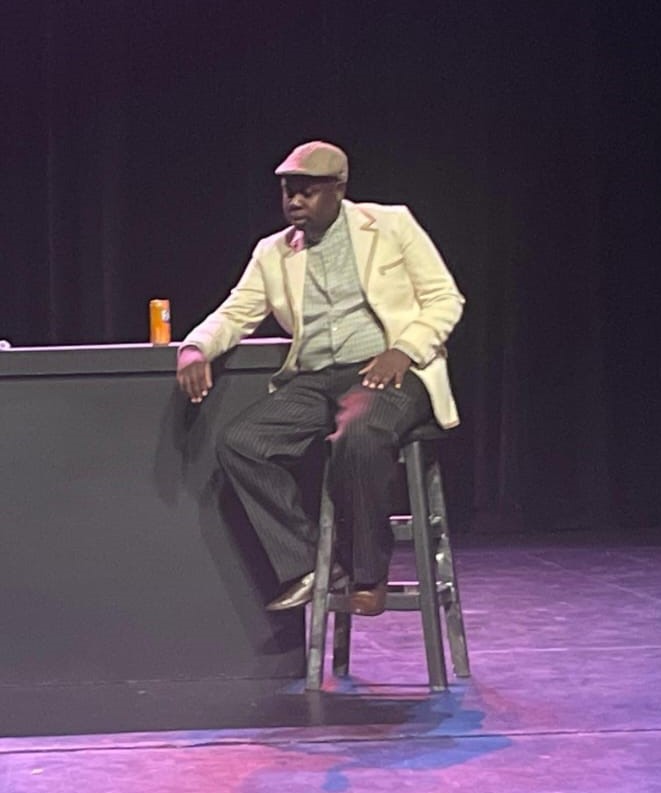
Freddy Letsoalo, a student writer and voice instructor at the University of the Witwatersrand, Johannesburg. PHOTO: Supplied/Freddy Letsoalo