
Where’s the human in the room?

GRAPHIC: Anke Spies and Daniélle Schaafsma
Artificial intelligence (AI) and questions around the fourth industrial revolution have become recent buzzwords. “But when you start scratching below the surface, there’s nothing below.” This is according to Emile Ormond, who has written a number of articles about the risks of AI. Ormond is one of the voices advocating for policy development around the regulation of AI in South Africa, where the impact of this presence is yet to be fully realised.
Artificial intelligence, or AI, truly became popular with the release of ChatGPT in November 2022, according to Emile Ormond, in an interview with SMF.
Ormond has a PhD in AI ethics and risk management from the University of South Africa, and has written a number of articles about the regulation of AI for South African publications.
AI is described as “a set of technologies that make computers do things that are thought to require intelligence when done by people” in an article by Will Heaven, senior editor for AI at MIT Technology Review.
This definition, as stated by Heaven, is hardly a comprehensive account of the wide field of computer science that is artificial intelligence.
The development of AI is taking place at a rapid pace, writes Ormond, in an article for Business Day. However, in South Africa, there is a growing concern about the lack of reliable regulatory frameworks that inform the use of AI, according to Ormond.
ChatGPT, like other similarly-functioning chatbots, is founded on the technology of a Large Language Model (LLM), which is a subset of the field of AI, according to Large Language Models: A Deep Dive.
Explained in the book Large Language Models: A Deep Dive, LLMs are programs designed to assist with writing, which function by receiving text as an input, recognising that text based on previously recognised data and subsequently generating text in response.
LLMs are a type of machine learning which encompasses algorithms which rely on a collection of data as examples to generate output, according to Andriy Burkov, author of The Hundred-Page Machine Learning Book.
How we got here
The turn of the 21st century saw the third industrial revolution in full swing.
What started in the late 1960s as a project to link computers across universities in the United States (US), quickly developed into the Internet and by 1993, the World Wide Web was established as the dominant tool for navigating the online space.
This is according to Ian Moll, a research fellow at the Centre for Researching Education and Labour (REAL) at the University of the Witwatersrand (Wits) in Johannesburg, in an academic paper.
The “information age”, as it became known due to the to globalised network of connections, consisted of a number of technological and digital advancements, according to Moll. He writes that hand-held devices, global communication services and three-dimensional printing are accepted as significant markers of the digital revolution.
The widespread use of what is arguably the largest digital disruptive force since the internet, however, has rapidly increased in the last three years, according to Uday Kamath and colleagues, the authors of the book Large Language Models: A Deep Dive.
Whether AI forms a part of the third industrial revolution or the marker of the fourth one is an academic debate, according to Ormond, but it will nonetheless result in disruption, he says.
Machine learning has been commonly used in many different programs, such as Google Translate, according to Ormond. However, large language models (LLMs) like ChatGPT were “ground zero”, or the vast majority of people’s first contact with AI, he says.
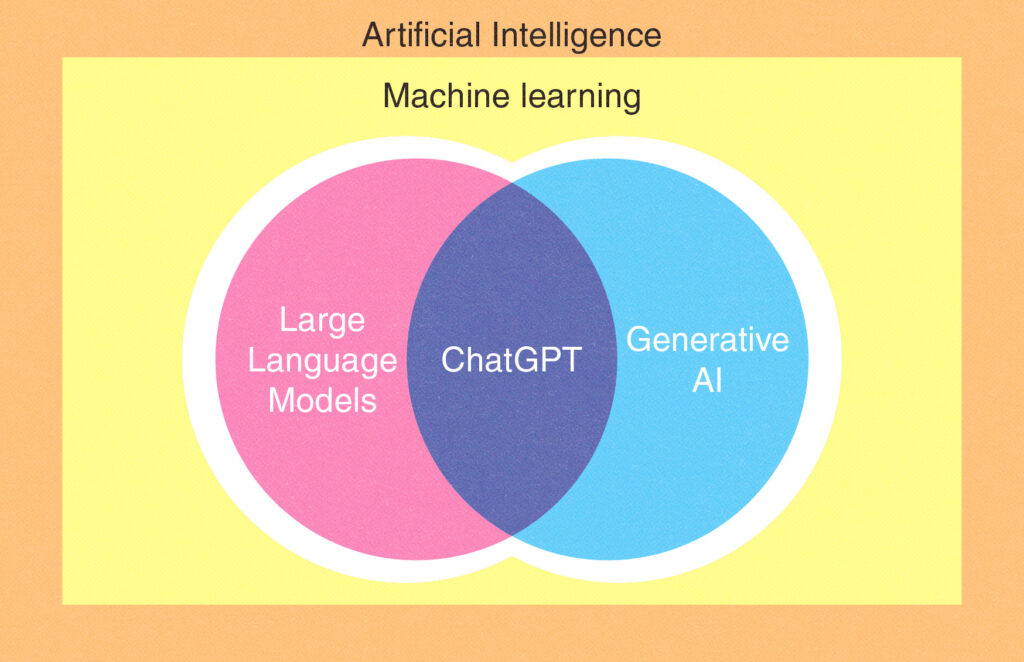
A diagram depicting the types of artificial intelligence that people commonly interact with.
Source: Large Language Models: A Deep Dive, The Hundred-Page Machine Learning Book.
GRAPHIC: Anke Spies
Staying ahead of the curve
The release of the National Artificial Intelligence Policy Framework by the department of communication and digital technologies in August 2024 is a step in the right direction, according to Ormond, but it does not comprehensively address the number of risks posed by AI, he says.
“I am yet to see the South African government understand how influential AI can and will be,” says Ormond, who emphasises that there has been no release of an AI policy for public input in South Africa.
The attentiveness of policymakers is crucial to mitigating risks posed by AI, as “policy makers will never be, or in very few instances, will be ahead of the curve on this”, says Ormond. “They’re always going to follow technological developments.”
Determining what these risks are depends on the kind of AI system used, according to Dr Tanya de Villiers-Botha.
De Villiers-Botha is the head of the Centre for Applied Ethics of Technology at Stellenbosch University (SU), as well as a member of the Global AI Ethics Consortium of the Institute for the Ethics of Artificial Intelligence, at the Technical University of Munich.
Generative AI, like ChatGPT, are LLMs that raise privacy concerns, according to De Villiers-Botha. The user’s data is either shared through having an account with the parent company or entering it directly into the system, she says.
LLMs produce an output based on a large sample of data that they are trained on, which includes a large chunk of the internet, according to Large Language Models: A Deep Dive. De Villiers-Botha explains that this training data is biased towards global north perspectives, especially that of young males, as “those are the people who put the most information on the internet”.
Additionally, LLMs have a specific feature called hallucinations, which, within this context, refers to the fabricated results made up by chatbots, according to Heaven in the MIT Technology Review. He states that this is not a bug, but rather an intrinsic feature of generative models.
“If you could do it without using the chatbot, then you really should,” says De Villiers-Botha.
While the European Union recently promulgated an act to regulate the use of AI, South Africa has not yet solidified any regulations into legislation, according to De Villiers-Botha.
According to Ormond, the lack of local policy “probably means we’ll fall behind, frankly”.
Watching TV for less than nine seconds
A median Gemini text prompt, according to a report released by Google in August 2025:
- Uses 0.24 watt-hours of energy, which is equal to running a standard microwave for one second, according to MIT Technology Review.
- Emits 0.03 grams of carbon dioxide
- Consumes 0.26 milliliters of water, which is about five drops.
AI is extremely energy-hungry, according to Ormond. However, this energy requirement, and the environmental impact thereof, is hardly discussed by policymakers in South Africa, he says.
“In a country like South Africa, there are so many priorities, right? So many pressing, systemic, in-your-face priorities – poverty, inequality, unemployment,” says Ormond. “Like, never mind that we have a shortage of energy for AI. We have a shortage of energy, full stop.”
However, De Villiers-Botha says “it should matter more”.
“It should feature more than it does at the moment in discussions,” she says. “Unfortunately, maybe as global warming gets worse, climate change gets worse, and the impact is more apparent, it’s going to be more prominent.”
In August 2025, Google released a report detailing the energy usage of their Gemini model per prompt.
According to this report, Google estimates that the average energy usage for a single Gemini text prompt is “equivalent to watching TV for less than nine seconds”.
The energy usage is that of the AI hardware that runs LLMs, as well as the additional infrastructure required to support the hardware, as explained in an article for the MIT Technology Review by Casey Crownhart.
However, Crownhart writes that Google’s report is limited – it does not address the full range of queries submitted to Gemini, and does not mention image or video generation. A large concern is the amount of queries Gemini receives, writes Crownhart. This number is not provided, and so a total energy estimate cannot be made, she writes.
“Never mind that we have a shortage of energy for AI. We have a shortage of energy, full stop.”
The legal question
“South Africa does not have a single ‘AI Act.’ For now, AI is handled through existing laws,” says Theshaya Naidoo, a PhD (Law) candidate at the University of KwaZulu-Natal, whose research focuses on neurotechnology and AI.
While the existing laws can be used to address the uses of AI to a certain extent, “South African courts have not yet built a clear body of case law applying these rules to AI-specific problems”, says Naidoo. “So we do not have firm judicial guidance on how well the old rules fit the new tools.”
Naidoo explains that in South Africa, there is currently a live debate on whether the country needs a dedicated legislative framework to regulate AI.
A positive development has been made in the healthcare sector, however. The South African Health Products Regulatory Authority (SAHPRA) has communicated on how to classify and handle model changes of AI-enabled medical devices, says Naidoo. “That is guidance for industry, not a general ‘AI law,’ but it matters in practice.”
Ethical concerns regarding privacy and bias are exemplified in the healthcare sector’s use of AI. According to Naidoo, patient images go to a cloud server for processing and if the server is outside of South Africa, it must be determined whether the destination offers “adequate protection” for data.
Naidoo adds that medical AI algorithms trained elsewhere may “mis-score local patients”.
As explained by the Special Programme for Research and Training in Tropical Diseases, computer-aided detection (CAD) products use AI to analyse chest x-rays for signs of tuberculosis (TB). CAD products provide an abnormality score based on a local threshold, which indicates probable TB.
Such thresholds “should be checked in the [South African] context before routine use”, says Naidoo.
Ultimately, a full “AI Act” will not feasibly be implemented in the near future, but guidance and sectoral regulations should be published by regulatory authorities like SAHPRA, says Naidoo.
Deciding what is “good” and “bad” behaviour when it comes to using AI must be determined to inform guidelines, and a common approach in the field of AI ethics has been to apply existing bioethical principles, according to De Villiers-Botha.
“They’ve kind of just taken those same principles and incorporated them into the AI space and added an extra principle, which is explicability,” explains De Villiers-Botha.
Explicability states that people must be able to understand the functionality of AI models, as well as their proper uses and limitations, according to a 2024 academic article by De Villiers-Botha.
The basic bioethical principles that are being applied to AI ethics, according to Dr Tanya de Villiers-Botha, the head of the Centre for Applied Ethics of Technology at Stellenbosch University (SU)
- Beneficence: You have to do good.
- Non-maleficence: You have to not do harm.
- Justice: You have to ensure that you don’t cause injustices.
- Autonomy: Protecting human autonomy, means something different in the AI context, rather than in the biomedical context.
- Explicability: People must understand why a certain output is given, and whether they want to engage with it.
The South African perspective
Popular LLMs, like ChatGPT, were developed in the global north by primarily English-speaking men, according to Large Language Models: A Deep Dive.
“We, as a people based in the global south, should be having conversations about […] our perspective on AI and how AI will affect us. We’re not going to influence Amazon, Microsoft, OpenAI on what they will do and what they won’t do,” says Ormond.
The impact of AI on primary and secondary education is also a concern in South Africa, according to Karen Walstra, who works as an educational consultant and is a South African Council of Educators (SACE) provider.
Walstra is the provincial ambassador for the Western Cape to the South African Artificial Intelligence Association, which is a non-governmental body aimed at promoting the responsible use of AI across governmental, corporate and academic sectors, according to their website.
“If we don’t address learners using AI, and teach them to prompt for learning or teach them to verify and analyse the responses, we could end up with learners who just accept the AI’s response as correct and accurate,” says Walstra.
“We need to teach people to be the human in the loop, to always check, validate, question the response. Be analytical, continually question,” she says.
Despite these challenges, there are ways in which AI is being put to use to benefit South Africans, says Walstra.
Leonora Tima is the founder of Gender Rights in Tech, or GRIT, which is a non-profit organisation championing technological aids to the gender-based violence epidemic in South Africa.
Tima notes the advantages of technology when it comes to anonymity and a lack of stigma, and states that while the “internet and technology is still predominantly built for global north white consumers”, if the technology is built as ethically as possible, these risks can be mitigated.
In addition to developing an app that functions as a panic button to alert rapid response, GRIT recently released Zuzi, which is a “knowledgeable, African and trauma-informed ChatBot” that survivors of gender-based violence can speak to, according to their website.
The development of the chatbot was informed by carrying out surveys amongst focus groups in various communities across South Africa, according to Tima. This information supplied the data that the chatbot was trained on, but things like voice recognition has not been possible, as the “voice recognition for African languages is still really poor”.
GRIT has an all-female leadership team, which is especially important when considering the representation of women in technology, says Tima.
“Women of colour in AI are even worse represented,” says Tima, who imagines that GRIT will keep an all-female leadership.

GRAPHIC: Anke Spies
Towards the future
“We will go through a period, or periods even, of disruption,” says Ormond. “How do we mitigate the risks of that as much as possible?”
AI can “influence and affect so many people and so many people’s lives so easily”, says De Villiers-Botha. While some people accept this technological advancement with open arms, others are extremely sceptical of what some people call “a massive social experiment”, according to De Villiers-Botha.
Despite this, the onslaught of AI is unavoidable, and does not seem to be slowing down anytime soon, says De Villiers-Botha.
The question, as posed by Ormond, is “how do we care for our citizens, our workforces, and keep them productive within this context? For that, you need to start thinking ahead”.
In a 2009 article written by Jim Hendler and Tim Berners-Lee, the inventor of the World Wide Web, the authors state that the coupling of AI with emerging technologies “will provide us with the ability to create a generation of systems that will empower humanity in new and transformative ways”.
De Villiers-Botha is “very sceptical about claims that AI systems are going to solve massive social problems”, especially not the systems themselves.
“Ultimately, it’s up to the people,” she says.